
Particle Physics
5 reportsWorked examples and detector events are treated as separate lines of evidence. Their combined record addresses how background events are rejected and how particles are identified, showing where limiting cases or counterexamples restrict the explanation.
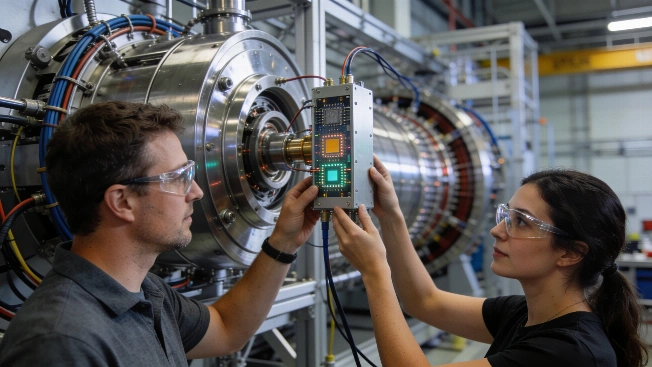
DOE Funds Quantum Sensors for High-Energy Physics Experiments
The U.S. Department of Energy is investing $7.3 million in eight collaborative projects to integrate quantum information science tools into particle accelerator and neutrino experiments, aiming to probe phenomena beyond the reach of classical detection
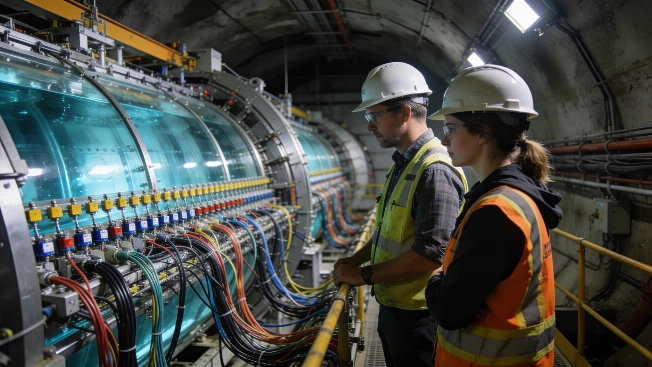
AI Systems Tested for Real-Time Neutrino Detection at DUNE
Researchers at the Deep Underground Neutrino Experiment are developing machine learning tools to process vast detector data, identify rare neutrino events, and monitor system health, aiming to improve the speed and reliability of particle physics research
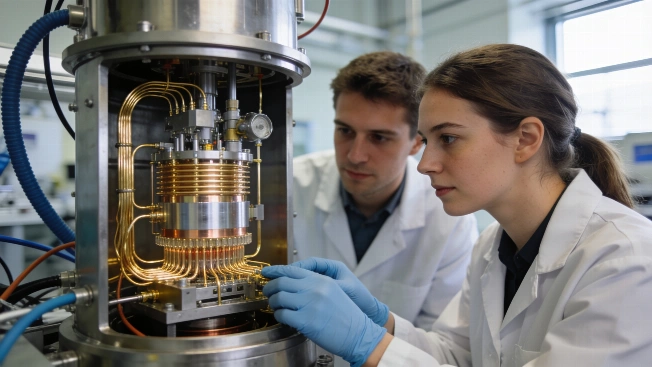
Quantum Computers Face Key Hurdles in Simulating Particle Physics
Quantum computers are being developed to simulate quantum systems that challenge classical supercomputers, but significant technical and theoretical barriers remain before these machines can reliably model particle physics or unify quantum information with general relativity
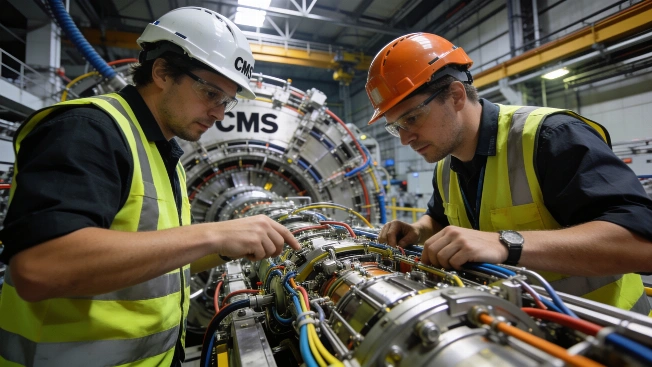
Large Hadron Collider Detects Particle Wake Predicted After Big Bang
Researchers at CERN's Large Hadron Collider have observed a long-sought wake effect in quark-gluon plasma, offering new insight into the behavior of matter under extreme conditions similar to those just after the Big Bang
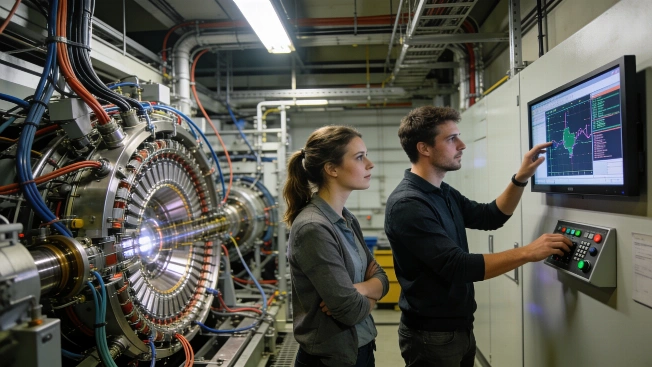
AI in Particle Physics: Discovery Without Full Understanding
Artificial intelligence is now central to particle physics, accelerating data analysis and experiment design. But as AI systems identify patterns beyond human intuition, researchers face new challenges in transparency, reproducibility, and scientific interpretation