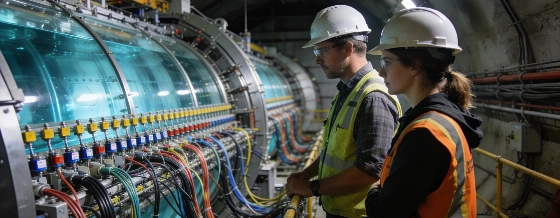
Researchers at the Deep Underground Neutrino Experiment are developing machine learning tools to process vast detector data, identify rare neutrino events, and monitor system health, aiming to improve the speed and reliability of particle physics research
The Deep Underground Neutrino Experiment (DUNE), currently under construction at the Sanford Underground Research Facility in South Dakota, is integrating machine learning systems to address the technical challenges of detecting and analyzing neutrino interactions. DUNE's detectors, located nearly 1.5 kilometers underground, are designed to capture the faint traces left by neutrinos-particles that interact so rarely with matter that trillions pass through the human body each second without effect. The experiment's scale and data volume have prompted researchers to develop artificial intelligence (AI) tools capable of sorting through petabytes of sensor data to identify meaningful events in near real time.
DUNE's primary detection system consists of massive cryostats, each intended to hold approximately 17,000 metric tons of liquid argon at temperatures near -184°C. When a neutrino collides with an argon atom, it produces a cascade of secondary particles, each leaving a distinct track in the detector. Traditional analysis methods require significant human effort and computational resources to reconstruct these events and infer the properties of the original neutrino. Machine learning models, including deep neural networks, are now being trained to automate the identification and reconstruction of these complex particle tracks, building on earlier work from the MicroBooNE experiment. The high-resolution imaging produced by DUNE's detectors presents both an opportunity for detailed analysis and a challenge for algorithmic reconstruction, as the volume and granularity of data can complicate event classification.
Real-Time Event Identification
One of the central aims of DUNE's AI integration is to enable rapid identification of rare or scientifically significant events, such as neutrino bursts from supernovae within the Milky Way. In these scenarios, the AI system is designed to act as a trigger, continuously monitoring incoming data for patterns consistent with a supernova neutrino burst. If a candidate event is detected, the system preserves a window of data spanning several seconds before and after the trigger, allowing for detailed post-event analysis and potential early alerts to the astronomical community. This approach could provide astronomers with advance notice of stellar explosions before their light reaches Earth, enabling coordinated multi-instrument observations.
Beyond astrophysical events, DUNE's machine learning tools are being developed to monitor the health and performance of the detector itself. With thousands of components operating in a remote underground environment, rapid detection of anomalies or failures is critical. Researchers are exploring the use of large language models to search historical maintenance records and suggest relevant troubleshooting steps, as well as predictive models that could identify subtle patterns indicating impending hardware issues before they result in downtime.
Data Scale and Technical Challenges
DUNE is expected to generate petabytes of data annually, requiring robust computational infrastructure and scalable AI pipelines. The collaboration, which includes more than 1,500 scientists and engineers from over 35 countries and CERN, is working to develop and test these AI systems in parallel with detector construction. The integration of machine learning into the experiment's workflow is intended to accelerate commissioning, improve sensitivity to rare events, and reduce the time between data collection and scientific analysis. However, the effectiveness of these systems will depend on their ability to generalize across diverse event types and maintain reliability under operational conditions.
While early results from related experiments such as MicroBooNE have demonstrated the feasibility of deep learning for liquid-argon detector data, DUNE's scale introduces new challenges in terms of data management, model validation, and system robustness. The collaboration is also addressing the need for human oversight, ensuring that automated event selection and anomaly detection remain transparent and auditable. The AI tools are being designed to support, rather than replace, expert review, with the goal of improving efficiency without compromising scientific rigor or safety.
Limits and Oversight
At present, DUNE's AI systems remain in development and have not yet been deployed in full operational mode. Their performance is being evaluated using simulated data and, where available, data from prototype detectors. Key metrics include event identification accuracy, false positive and false negative rates, and latency in triggering and anomaly detection. The collaboration has not yet reported independent verification of these systems' performance under live experimental conditions. As with all machine learning applications in scientific research, the risk of bias, overfitting, and unanticipated failure modes remains a concern, particularly given the rarity and diversity of target events.
Human operators will continue to play a central role in reviewing AI-flagged events, validating system outputs, and responding to detector anomalies. The integration of AI into DUNE's workflow reflects a broader trend in particle physics toward automated data analysis, but it does not eliminate the need for expert judgment or institutional oversight. The long-term impact of these systems will depend on their demonstrated reliability, transparency, and ability to support reproducible scientific results.
Neutrino detection in experiments like DUNE relies on reconstructing the paths of secondary particles produced when a neutrino interacts with a target atom. Machine learning models used for this purpose are typically trained on large datasets of simulated events, where the true particle trajectories are known. These models learn to classify and reconstruct tracks from raw detector images, but their performance can be sensitive to differences between simulated and real data-a challenge known as domain shift. Ongoing validation, calibration, and human review are essential to ensure that automated systems remain accurate and trustworthy as experimental conditions evolve.