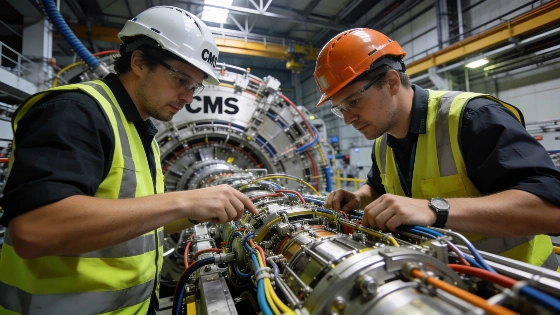
Researchers at CERN's Large Hadron Collider have observed a long-sought wake effect in quark-gluon plasma, offering new insight into the behavior of matter under extreme conditions similar to those just after the Big Bang
Physicists working at CERN's Large Hadron Collider have reported the first clear observation of a particle wake effect in quark-gluon plasma, a state of matter thought to have filled the universe microseconds after the Big Bang. The finding, accepted for publication in Physical Review Letters on June 25, provides experimental evidence for a phenomenon predicted by theory but elusive in data for more than two decades.
LHC Collisions Reveal a Long-Predicted Plasma Wake
The LHC, the world's most powerful particle accelerator, recreates conditions similar to the early universe by colliding heavy atomic nuclei, such as lead, at nearly the speed of light. These collisions generate temperatures and densities high enough to free quarks and gluons from protons and neutrons, forming a short-lived quark-gluon plasma.
As energetic particles, or jets, move through this plasma, they are expected to lose energy and momentum, creating a wake in the medium analogous to the disturbance left by a boat moving through water.
Previous attempts to detect this so-called diffusion wake relied on events where a jet was produced alongside a Z boson, but the resulting signals were subtle and often masked by background effects. In the new study, researchers used a different approach: they analyzed collisions that produced two back-to-back jets, known as dijet events, which allowed for a cleaner separation of the wake signal from other processes.
Dijet Events Exposed the Particle Depletion Signal
By examining the distribution of particles in the aftermath of these lead-lead collisions, the team identified a distinct depletion of particles behind the direction of the jets, especially at lower momenta. This pattern matches theoretical predictions for a diffusion wake in quark-gluon plasma.
The effect was most pronounced in central collisions, where the overlap of the nuclei, and thus the volume of plasma created, was greatest.
To put the result in context, the LHC's heavy-ion program routinely achieves collision energies of 5.02 teraelectronvolts per nucleon pair, generating temperatures exceeding several trillion kelvins. The observed wake effect emerged from data collected by the CMS experiment, which recorded millions of lead-lead collisions to build up the statistical power needed for this analysis.
The research team's findings represent a significant step in characterizing the properties of quark-gluon plasma and understanding how energetic particles interact with this extreme state of matter.
The Finding Could Refine Models of Jet Energy Loss
While the detection of the diffusion wake supports long-standing theoretical models, it also opens new questions about the detailed dynamics of quark-gluon plasma and the mechanisms by which jets lose energy.
The result complements other recent advances in high-energy astrophysics and cosmology, such as the imaging of distant galaxy clusters merging in the early universe, as seen in recent observations with the James Webb Space Telescope.
The study's authors emphasize that further measurements, including comparisons across different collision systems and energies, will be needed to refine models of jet-plasma interactions. The LHC's ongoing upgrades and future data-taking campaigns are expected to provide even more precise information about the behavior of matter under the most extreme conditions accessible in the laboratory.
Understanding the diffusion wake in quark-gluon plasma is not only relevant for particle physics but also for reconstructing the evolution of the early universe, where such matter dominated before cooling into the protons and neutrons that make up ordinary atoms today.
Why Quark-Gluon Plasma Matters
Quark-gluon plasma is a phase of matter in which quarks and gluons, usually confined within protons and neutrons, exist freely in a hot, dense medium. This state is believed to have prevailed in the first microseconds after the Big Bang.
In modern experiments, such as those at the LHC, quark-gluon plasma is created for fleeting moments by colliding heavy ions at high energies. Studying how energetic particles interact with this plasma, particularly how they lose energy and create wakes, helps physicists probe the fundamental properties of strong interactions and the collective behavior of matter at extreme temperatures and densities.