Artificial intelligence is now central to particle physics, accelerating data analysis and experiment design. But as AI systems identify patterns beyond human intuition, researchers face new challenges in transparency, reproducibility, and scientific interpretation
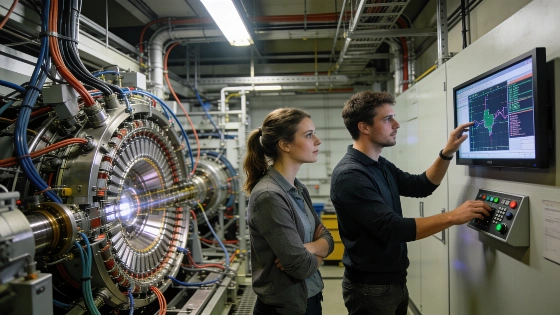
Artificial intelligence (AI) has become an integral part of experimental physics, particularly in high-energy particle research. At facilities such as CERN's Large Hadron Collider (LHC), machine learning algorithms are now embedded in the workflow, from data collection to analysis. These systems can identify rare events, compress vast datasets, and even propose new experimental directions. However, as AI models grow more complex, the mechanisms by which they reach their conclusions often remain opaque, raising questions about scientific transparency and the limits of human understanding.
AI-Driven Data Analysis
Machine learning (ML) first gained prominence at the LHC during the search for the Higgs boson. Algorithms were trained to distinguish rare Higgs decay signatures-such as two-photon or four-lepton events-from more common Standard Model backgrounds. This approach increased the sensitivity of the search, reducing the amount of data required by up to 125% compared to traditional methods. Without ML, some measurements would have needed more than double the data to reach the same statistical significance.
Since then, the role of AI has expanded. Neural networks are now used to compress detector data, accelerate simulations, and flag anomalies in billions of particle collisions. Unlike earlier supervised learning approaches, which required labeled examples, current methods often use self-supervised learning to identify and preserve important features without explicit instruction. This allows researchers to detect unexpected patterns that may signal new physics, even when the form of the signal is unknown.
The Black Box Challenge
The power of AI in physics comes with a significant trade-off: interpretability. Modern neural networks can uncover correlations and structures in data that are difficult for humans to trace. As a result, even the developers of these systems may not fully understand how a particular result was obtained. In a field where extraordinary claims require extraordinary evidence, this lack of transparency can complicate the process of scientific validation.
Reproducibility remains a core principle. In particle physics, large review committees and open sharing of code and data help ensure that results can be independently verified. However, reproducing AI-driven results may require access not only to datasets and algorithms, but also to model architectures, training conditions, and computational environments. These additional layers of complexity can make robust verification more challenging as AI becomes more deeply integrated into research workflows.
AI in Experiment Design
AI's influence is not limited to data analysis. At Argonne National Laboratory, researchers have demonstrated autonomous systems that propose, execute, and refine materials experiments. In 2023, an AI-driven platform conducted 355 experiments in 17 days, synthesizing 41 new materials. Here, AI does not simply analyze results after the fact-it actively determines which experiments to run, closing the loop between hypothesis and measurement. This approach is now being explored in other areas of physics, including the design of new detectors and the optimization of experimental parameters.
While these systems can accelerate discovery, they also shift the role of the researcher. Scientists increasingly act as supervisors, steering AI agents and interpreting their outputs rather than performing every step manually. This raises questions about how expertise is developed and maintained, especially as routine tasks become automated.
Scientific Value and Communication
The integration of AI into physics is changing how scientific value is measured. As technical barriers to analysis and experimentation are lowered, originality and the quality of research questions may become more important than sheer productivity. At the same time, AI-generated scientific writing is prompting new scrutiny. Platforms such as arXiv have introduced policies to address the risk of unverified or low-quality AI-generated submissions, including one-year bans for authors who submit papers with fabricated references or unedited chatbot output.
These developments place greater responsibility on readers, reviewers, and future researchers to assess the validity and significance of scientific claims. The ease of generating text and results with AI tools increases the risk of noise in the literature, making critical evaluation and transparent reporting more important than ever.
Training and the Future of Expertise
The automation of routine research tasks by AI also affects the training of new physicists. Traditionally, expertise is built through hands-on experience and repeated problem-solving. If AI systems take over many of these steps, there is a risk that early-career researchers may miss opportunities to develop essential skills. This concern extends to education, where generative AI can now produce essays, solve problem sets, and complete programming assignments in seconds.
Despite these challenges, many in the field view AI as a tool for collaboration rather than competition. The history of physics is marked by the adoption of new technologies-from slide rules to computers-that have changed how research is conducted without eliminating the need for human insight. AI may simply represent the next stage in this progression, expanding the range of questions that physicists can ask and answer.
Limits and Open Questions
AI's ability to identify patterns and propose hypotheses does not guarantee understanding. As models become more sophisticated, there is a real possibility that machines will uncover physical phenomena faster than researchers can interpret them. This raises fundamental questions about the nature of scientific explanation and the role of human judgment in validating results. While fully autonomous scientific systems remain a theoretical possibility, current practice still relies on human oversight to ensure that AI-generated findings are robust, reproducible, and meaningful.
In particle physics and beyond, the challenge is not simply whether AI can discover new truths, but whether the scientific community can maintain the standards of evidence, transparency, and critical inquiry that underpin progress. As AI becomes more deeply embedded in research, the ability to ask the right questions-and to understand the answers-remains central to the scientific enterprise.
One key concept in this context is reproducibility. In experimental physics, reproducibility means that independent researchers can obtain consistent results using the same methods and data. For AI-driven research, this requires not only access to datasets and code, but also detailed information about model architectures, training procedures, and computational environments. Ensuring reproducibility is essential for building trust in scientific results, especially as AI systems become more complex and their decision-making processes less transparent.