The U.S. Department of Energy is investing $7.3 million in eight collaborative projects to integrate quantum information science tools into particle accelerator and neutrino experiments, aiming to probe phenomena beyond the reach of classical detection
The U.S. Department of Energy (DOE) has allocated $7.3 million to support eight multi-institutional research projects under its "Quantum Outposts on the Energy and Intensity Frontiers" initiative. These projects, coordinated by the DOE Office of Science's High Energy Physics program, are designed to embed quantum information science (QIS) methods into experimental particle physics, with a focus on advancing measurement capabilities in accelerator-based and neutrino experiments.
Quantum Sensors in Collider Physics
One of the funded efforts, led by Brookhaven National Laboratory in partnership with the University of Pittsburgh, will investigate quantum information signatures in high-energy particle collisions. The team plans to analyze entanglement and quantum information flow in data from the Large Hadron Collider (LHC) and the planned Electron-Ion Collider (EIC). By examining how quantum information is preserved or lost during subatomic collisions, researchers hope to identify rare physical processes that may not be accessible through conventional detection techniques.
Neutrino Detection and Instrumentation
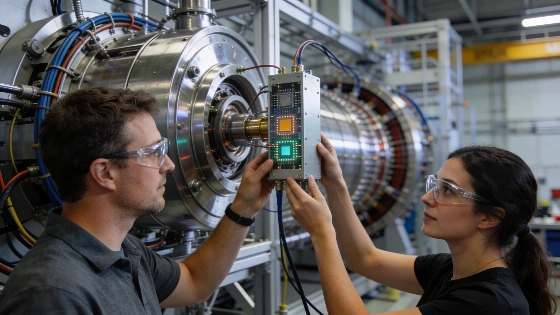
Several projects within the initiative will develop quantum sensors engineered for high-intensity, low-noise environments, such as those encountered in the Deep Underground Neutrino Experiment (DUNE). These sensors are expected to improve sensitivity to weak signals and enable new types of measurements in neutrino physics. The integration of quantum-enhanced instrumentation aims to address longstanding challenges in detecting elusive particles and rare events, where classical sensors are limited by noise and background interference.
Policy Alignment and Funding Structure
The funding is provided under notice DE-FOA-0003600 and aligns with the National Quantum Initiative Act, recent executive orders on quantum innovation, and the DOE's Genesis Mission. The Quantum Genesis track specifically targets the delivery of scientifically relevant quantum computing applications by 2028. The $7.3 million budget is distributed over up to three years, with $3.2 million allocated from Fiscal Year 2026 funds and the remainder contingent on future congressional appropriations.
Technical and Experimental Context
Quantum sensors and algorithms are being deployed to probe phenomena that challenge the Standard Model of particle physics. For example, the use of entanglement-based measurements in collider experiments could reveal subtle correlations or information loss mechanisms not visible to classical analysis. In neutrino research, quantum devices may offer improved discrimination between signal and background, potentially enabling the detection of rare interaction channels. These efforts build on recent advances in quantum simulation and sensing, such as those described in recent work using neutral-atom quantum simulators to probe field theory spectra.
While the integration of quantum technologies into high-energy physics remains at an early stage, the funded projects are expected to provide experimental data on the performance, noise resilience, and practical limitations of quantum sensors in real accelerator and underground environments. The results will inform both the design of future experiments and the development of quantum devices capable of operating under demanding physical conditions.
Quantum sensors exploit nonclassical properties such as entanglement and superposition to achieve measurement sensitivities beyond classical limits. In high-energy physics, these sensors can be engineered to detect extremely weak signals or rare events by reducing noise and enhancing signal discrimination. However, the practical deployment of quantum sensors in large-scale experiments requires careful engineering to maintain quantum coherence and minimize environmental disturbances. The success of these efforts will depend on both advances in quantum device fabrication and a detailed understanding of the noise sources present in accelerator and underground laboratory settings.