
Habitable Zone
5 reportsThe main lines of inquiry around Habitable Zone include source populations, competing physical models, and multiwavelength detection. Complementary views of multiwavelength detection come from instrument calibration and population statistics, but the conclusion remains bounded because the conclusion remains provisional because selection effects and uncertain source distances can alter inferred rates or energies.
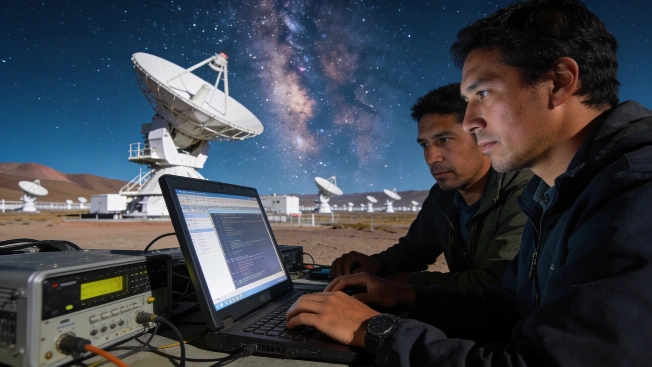
Trillion-Mile Gas Streamer Tilts Planet-Forming Disk in GW Orionis
Astronomers using ALMA have observed a massive gas streamer disrupting the planet-forming disk around the young triple-star system GW Orionis, offering new insight into the origins of misaligned planetary orbits

Exoplanets Smaller Than Mars May Lose Atmospheres Too Quickly for Life
A new planetary modeling study suggests rocky exoplanets must be at least 80% the width of Earth to retain atmospheres for billions of years, narrowing the search for potentially habitable worlds around sun-like stars

AI Struggles With Unknowns in Search for Extraterrestrial Life
A Michigan State University study using digital life simulations reveals that artificial intelligence can misclassify unfamiliar molecular patterns as signs of life, raising concerns for future missions seeking biosignatures beyond Earth

Atmosphere detected on rocky exoplanet in habitable zone
Astronomers have identified helium escaping from LHS 1140 b, a super-Earth orbiting in its star's habitable zone, using infrared spectroscopy. The finding offers the strongest evidence yet that a rocky exoplanet can retain an atmosphere for billions of years
Atmosphere Detected on Rocky Exoplanet in Habitable Zone
Astronomers have directly detected helium in the atmosphere of LHS 1140 b, a rocky exoplanet orbiting within its star's habitable zone, using infrared spectroscopy. The finding raises new questions about atmospheric survival and planetary habitability.