
Paleoecology
2 reportsResearch on Paleoecology investigates ancient organisms or environments through fossils, geology, dating, and evolutionary comparison. Current understanding relies on stable isotopes, food webs, and primary observations, with uncertainty tracked across measurement, classification, and reconstruction.
Questions about how ancient ecosystems are reconstructed are tested against comparative measurements and model results. A second focus is which proxies indicate climate, showing how sparse measurements or incomplete records limit certainty.
Questions about how ancient ecosystems are reconstructed are tested against comparative measurements and model results. A second focus is which proxies indicate climate, showing how sparse measurements or incomplete records limit certainty.
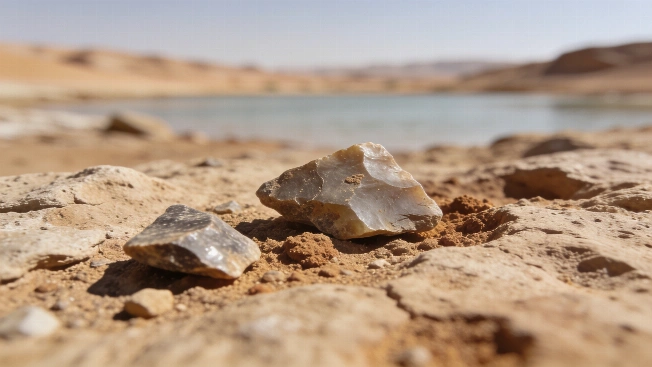
A 125,000-Year-Old Lake Reveals Human Life in Arabia
At Uruq al-Julaybah, a reconstructed 340-square-kilometer lake and thousands of stone artifacts place human activity in wetter Arabia about 125,000 years ago; residues offer clues to tool use and plant processing
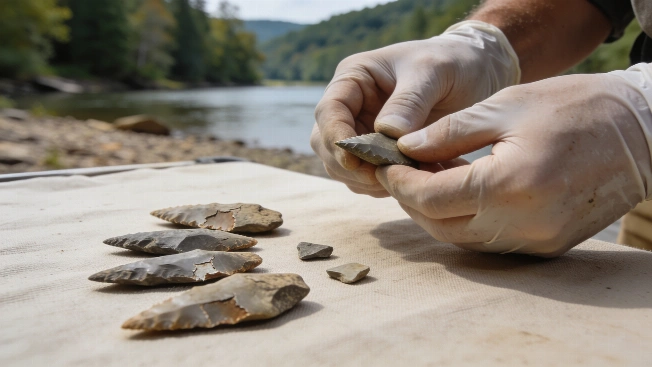
Resharpened Clovis Points Track Early Adaptation in Tennessee
An analysis of 489 Clovis and Cumberland projectile points from the Tennessee River Valley shows how early hunter-gatherers changed their use of stone as they learned the field