An analysis of 489 Clovis and Cumberland projectile points from the Tennessee River Valley shows how early hunter-gatherers changed their use of stone as they learned the landscape
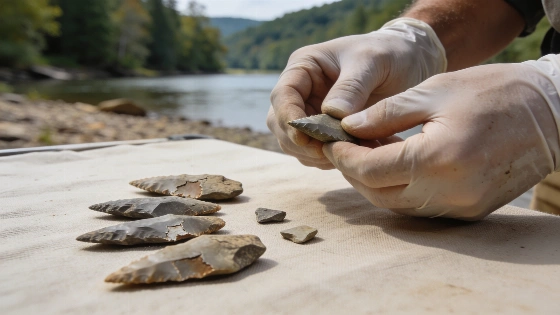
Clovis groups did not simply discard worn projectile points in the Tennessee River Valley. A study of 489 stone points suggests that the earliest occupants repeatedly resharpened many of them, conserving usable tools while they learned where suitable stone could be found. The sample comprises 326 Clovis points and 163 Cumberland points drawn from the Paleoindian Database of the Americas.
The research was conducted by Jesse Tune of the University of Mississippi and Shane Miller of the University of Alabama. Their comparison focuses on the life histories of artifacts: how much material was removed during sharpening, how long a point remained useful and the condition in which it was ultimately discarded.
The pattern changed several centuries later. Cumberland points were sometimes left behind while they could still function, a contrast that researchers interpret as evidence of growing familiarity with local raw-material sources rather than as a simple change in hunting technology. The age ranges used for comparison are approximately 13,050-12,750 years ago for Clovis and 12,800-12,000 years ago for Cumberland, although those intervals overlap and should not be treated as evidence of a strictly sequential replacement of one group by another.
The study, reported in the Journal of Archaeological Method and Theory, compares projectile points associated with the Clovis and Cumberland archaeological cultures. Clovis-associated populations were present in the region during the Pleistocene, when mastodons, mammoths and other megafauna occupied North American environments that no longer exist.
Stone points were replaceable components of hunting weapons. That makes their treatment archaeologically useful: repeatedly sharpening an exhausted edge requires time and preserves a tool that could otherwise have been abandoned, while leaving a still-functional point suggests that replacement was not prohibitively difficult.
To estimate reduction and wear, the researchers used the ratio of blade length to maximum point length, expressed as BL:ML. The apparent discard threshold was close for both traditions-about 0.50 for Clovis and 0.49 for Cumberland-allowing the degree of exhaustion to be compared across the two assemblages.
About 69.4 percent of the Clovis bases were discarded in a range associated with near-complete exhaustion, compared with 50 percent of the Cumberland bases. This difference quantitatively supports more intensive reuse of Clovis points, while also showing that the Cumberland pattern was not one of complete disregard for tool conservation.
The evidence does not show exactly where every group obtained its stone or how often people moved between particular locations. It does show a practical difference in the life histories of the artifacts. Clovis examples were frequently reworked, whereas Cumberland examples could be discarded before damage made them unusable.
That distinction matters because a projectile point is not only a finished artifact. Its fractures, edge alterations and remaining form record decisions made during manufacture, transport, maintenance and disposal. In this respect, the analytical logic resembles other scientific approaches in which repeated physical measurements reveal changing behavior more reliably than an isolated specimen.
When Clovis groups entered the Tennessee River Valley, they would have had limited knowledge of its geology and resource distribution. Carrying stone from an unknown or distant source would have imposed a cost on highly mobile hunter-gatherers, particularly in a world without pack animals. Reworking a point could therefore reduce the need to locate or transport replacement material.
Shane Miller, a co-author of the study, links this behavior to the physical limits of mobility. People moving frequently had to decide which tools were worth carrying and which could be discarded. The archaeological record preserves that logistical problem in the altered edges and surviving forms of the points.
By the time Cumberland groups occupied the same broad region, their knowledge of available resources may have been greater. Jesse Tune has noted that the points can provide information about raw-material provenance, approximate use within the cultural chronology and repeated application. The researchers propose that familiarity with the landscape could have enabled people to make replacements locally rather than carry damaged items for later repair.
A comparable principle applies to landscape archaeology today. An earlier survey of hidden roads near Machu Picchu, described in an earlier landscape survey, also shows why material traces must be read as evidence of movement through specific environments rather than as isolated objects.
Professor Jesse Tune of the University of Mississippi frames the comparison as a record of decision-making in an unfamiliar environment. The researchers use the points to reconstruct behavior, not to claim that the artifacts capture every aspect of Ice Age life. Their interpretation rests on repeated patterns across a large sample rather than on a single unusually preserved object. An institutional summary from the University of Alabama also identifies the study team and dataset.
The study also places tool maintenance within a wider economic calculation. A mobile group had to balance the weight of raw material, the time required to make or repair a point and the chance of finding suitable stone at the next destination. As knowledge accumulated across generations, the balance could shift from maximum conservation toward selective replacement.
The comparison has limits. Resharpening can be influenced by the quality of the stone, the kind of damage sustained, the intended use of a point and the circumstances of its final deposition. Abandoning a functional point does not by itself prove that a group knew the location of a nearby quarry, just as repeated sharpening does not prove that raw material was scarce everywhere in the region.
The authors also identify an alternative explanation: differences in the wider hunting system may have affected how points were maintained. For example, hunters may have used different methods for removing points from shafts before resharpening them. The contrast therefore cannot be attributed solely to familiarity with the landscape.
Even with those qualifications, the sequence offers a strong archaeological signal. The points record changing relationships between mobility, raw materials and local knowledge, showing how adaptation can be traced through maintenance decisions rather than only through settlement remains or animal bones. Similar emphasis on transparent measurement and uncertainty is central to the reproducibility standards associated with journals such as Nature and research communities at MIT, although those institutions were not involved in this study.
Projectile-point analysis works because use leaves physical traces. Resharpening removes part of an artifact and changes its outline, while fractures and edge damage can indicate repeated episodes of use or repair. Those traces rarely identify a single event, but patterns across many specimens can support interpretations of resource management. Here, the 489-point sample makes the contrast between Clovis and Cumberland practices more informative than any lone artifact would be.
The evidence therefore supports a measured conclusion: early hunter-gatherers in the Tennessee River Valley adjusted how they maintained and discarded stone points as their knowledge of the landscape developed. It does not prove a single migration route, identify every source of stone or reconstruct the full social lives of the people who made the artifacts. Its value lies in something more concrete-the demonstration that familiarity with a new environment can be detected in the practical afterlife of tools, and that archaeology can recover this process from wear, repair and discard.