
Standard Model
3 reportsWork involving Standard Model is reported through connections to other theories, while also considering open theoretical questions and mathematical predictions. The treatment of mathematical predictions keeps independent experiments separate from quantitative predictions until their assumptions and scales are compared; the comparison must account for the fact that agreement within one regime does not guarantee validity beyond tested conditions.
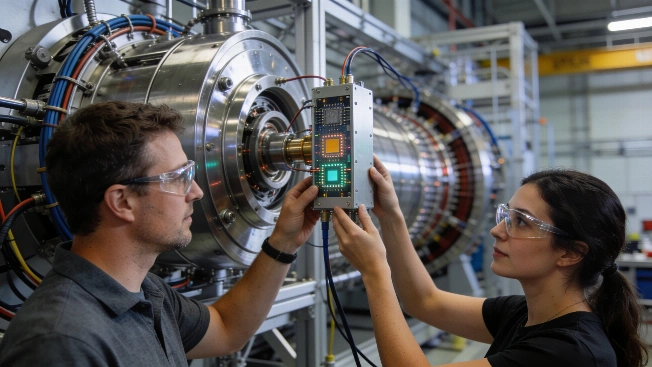
DOE Funds Quantum Sensors for High-Energy Physics Experiments
The U.S. Department of Energy is investing $7.3 million in eight collaborative projects to integrate quantum information science tools into particle accelerator and neutrino experiments, aiming to probe phenomena beyond the reach of classical detection
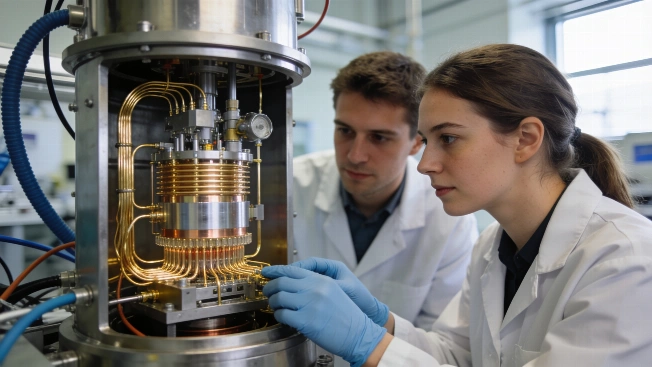
Quantum Computers Face Key Hurdles in Simulating Particle Physics
Quantum computers are being developed to simulate quantum systems that challenge classical supercomputers, but significant technical and theoretical barriers remain before these machines can reliably model particle physics or unify quantum information with general relativity
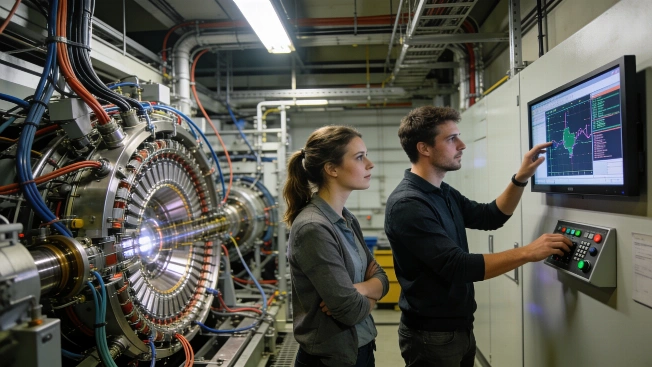
AI in Particle Physics: Discovery Without Full Understanding
Artificial intelligence is now central to particle physics, accelerating data analysis and experiment design. But as AI systems identify patterns beyond human intuition, researchers face new challenges in transparency, reproducibility, and scientific interpretation