
Redshift
11 reportsThe key evidence surrounding Redshift comes from source populations, while also considering competing physical models and source environment. The discussion asks what can be established from population statistics about competing physical models and whether a compatible result appears in independent detections; the comparison must account for the fact that selection effects and uncertain source distances can alter inferred rates or energies.
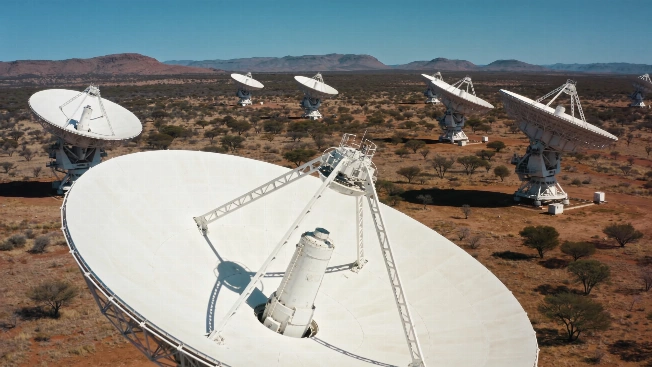
MeerKAT Telescope Maps Ancient Hydrogen Across Billions of Light Years
Researchers using South Africa's MeerKAT radio telescope have detected faint hydrogen signals from galaxies 4 to 5 billion light-years away, offering a new approach to mapping the universe's large-scale structure through radio intensity mapping
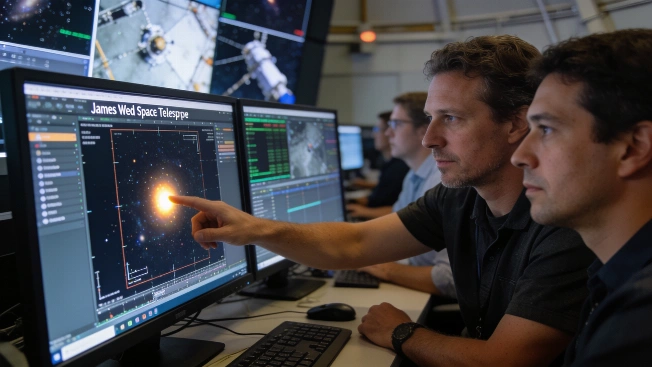
Webb Telescope Spots Candidate Black Hole Star in Early Universe
Astronomers using the James Webb Space Telescope have identified a luminous, solar-system-sized object from 660 million years after the Big Bang, offering the strongest evidence yet for a hypothesized 'black hole star' class.
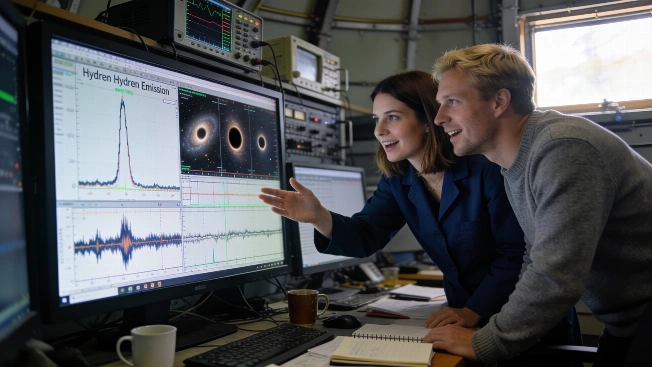
Webb Telescope Reveals Three Supermassive Black Holes in Distant Galaxy
Astronomers using the James Webb Space Telescope have identified three supermassive black holes within a single galaxy seen as it was 12.5 billion years ago, offering new evidence for rapid black hole growth through mergers in the early universe
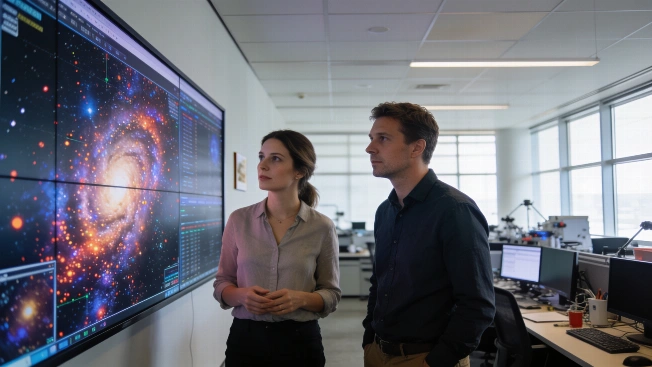
eROSITA X-ray Survey Nearly Doubles Known High-Energy Cosmic Sources
The eROSITA X-ray telescope's latest data release catalogs nearly 2 million X-ray sources, offering an unprecedented view of black holes, galaxy clusters, and stellar remnants across the universe
Astronomers Map 4 Billion Cosmic Objects in Largest 2D Sky Survey
A new 2D map of the universe, built from 13 years of ground and space-based observations, catalogs 4 billion stars, galaxies, and other objects, offering an unprecedented resource for future astronomical research
Webb Telescope Study Links Little Red Dots to Black Hole Activity
Astronomers using the James Webb Space Telescope have traced the origins of mysterious 'little red dots' in deep space, suggesting these compact sources are linked to phases of intense supermassive black hole activity
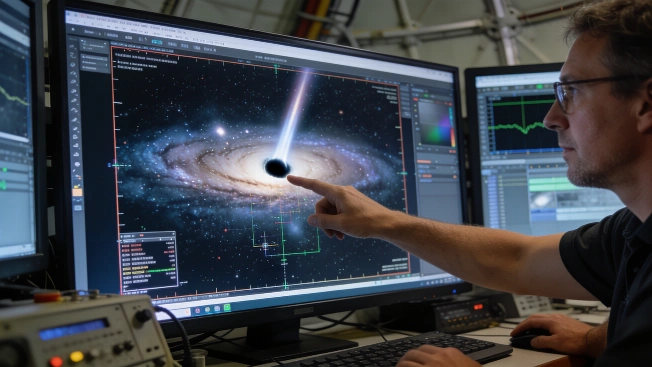
Chandra X-ray Data Reveal Black Hole Jet Disrupting Early Galaxy
Astronomers using the Chandra X-ray Observatory have detected a jet from a supermassive black hole disturbing gas in a distant galaxy known as the 'red potato,' offering new insight into how black holes can suppress star formation in the early universe
Webb Telescope Links 'Little Red Dots' to Ancient Star Clusters
Astronomers using the James Webb Space Telescope have traced mysterious 'Little Red Dots' in the early universe to the possible origins of globular clusters, offering new clues about how these dense stellar systems formed
Webb Telescope Reveals 4.4-Billion-Year-Old Galaxy Cluster in Formation
The James Webb Space Telescope has imaged the young galaxy cluster MACS J0553.4-3342, capturing light that began its journey 4.4 billion years ago and offering new insight into the assembly of large-scale cosmic structures
Webb data links early red dots to UV-bright companions and black hole seeds
A new analysis of James Webb Space Telescope images suggests that compact 'little red dots' in the early universe may form near ultraviolet-bright companions, offering a possible route to the rapid birth of supermassive black holes
Webb Telescope Reveals Merging Young Galaxy Cluster 4.4 Billion Light-Years Away
NASA's James Webb Space Telescope has imaged the galaxy cluster MACS J0553.4-3342 as it appeared 4.4 billion years ago, capturing two massive sub-clusters in the process of merging and highlighting the gravitational effects shaping distant galaxies