A new analysis of James Webb Space Telescope images suggests that compact 'little red dots' in the early universe may form near ultraviolet-bright companions, offering a possible route to the rapid birth of supermassive black holes
Observations from the James Webb Space Telescope (JWST) have revealed a population of compact, luminous objects-dubbed 'little red dots' (LRDs)-that appeared when the universe was less than a billion years old. A recent study proposes that these enigmatic sources may form in the presence of nearby ultraviolet-bright companions, providing a plausible mechanism for the early emergence of supermassive black holes.
JWST observations and the LRD sample
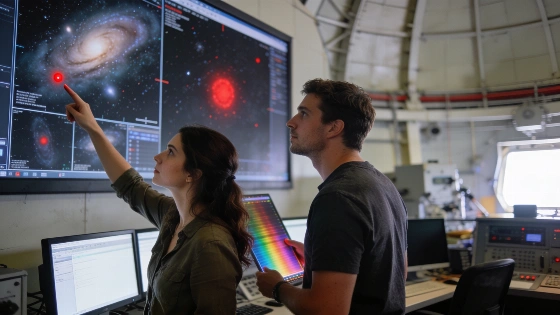
Using JWST's deep-field infrared imaging, researchers identified 83 LRDs in regions corresponding to a cosmic age of roughly 600 million to 1 billion years after the Big Bang. These objects stand out for their compactness and brightness in red optical and infrared wavelengths, but their physical nature has remained uncertain. The new analysis focused on whether LRDs are isolated or associated with other luminous sources in their immediate environment.
In the sample, 36 of the 83 LRDs-particularly the brightest-were found to have at least one close companion emitting strongly in blue and ultraviolet light. These companions are estimated to have masses between several hundred million and a few billion times that of the Sun, consistent with early star clusters or small galaxies. The spatial proximity and relative brightness of these pairs suggest a physical association rather than a chance alignment.
Ultraviolet irradiation and direct-collapse black holes
The study proposes that intense ultraviolet (UV) radiation from these companions plays a critical role in shaping the fate of nearby gas clouds. Under normal conditions, cold molecular gas fragments and forms stars. However, strong UV irradiation can suppress this fragmentation, allowing a massive gas cloud to collapse directly into a supermassive star or a so-called 'black hole star.' Such an object could rapidly collapse into a black hole with a mass between 100,000 and 1 million solar masses, bypassing the supernova stage that typically ends the life of massive stars.
This scenario offers a potential solution to the longstanding puzzle of how supermassive black holes grew so quickly in the early universe. The presence of UV-bright companions could provide the necessary conditions for direct-collapse black hole formation, seeding the growth of the massive black holes observed at high redshift.
Interpreting the spectral signatures
The combined emission from LRDs and their companions produces a distinctive spectral signature: strong red optical and infrared light from the LRD, blue and UV light from the companion, and a dip between these bands due to absorption by hydrogen gas. This pattern is consistent with a dense cocoon of gas surrounding the LRD, absorbing intermediate wavelengths. The study suggests that all LRDs may have such companions, but some pairs may be too close to resolve with current JWST data, while others could be separated by greater distances than the survey's search radius.
These findings complement previous JWST results that have mapped gas flows around supermassive black holes, revealing the complex interplay between gas dynamics and black hole growth in the early universe. For example, recent work has shown how gas accretion can regulate black hole mass, as discussed in a related analysis of Webb's mapping of gas feeding a supermassive black hole.
Implications and open questions
If the proposed mechanism is correct, the merging of LRDs and their UV-bright companions could contribute to the assembly of massive galaxies seen today. However, the study acknowledges that not all companions may be detectable with current resolution, and some associations could be missed. The precise evolutionary path of LRDs remains uncertain, and further observations will be needed to confirm whether these objects consistently evolve into supermassive black holes or massive galaxies.
The research, published in The Astrophysical Journal Letters, highlights the importance of high-resolution, multi-wavelength imaging for disentangling the origins of compact sources in the early universe. As JWST continues to survey the distant cosmos, astronomers expect to refine models of black hole and galaxy formation during the universe's first billion years.
Understanding the formation of supermassive black holes in the early universe requires careful interpretation of both direct imaging and spectral data. JWST's infrared sensitivity allows astronomers to detect faint, distant objects whose light has been stretched by cosmic expansion. By analyzing the spatial and spectral relationships between LRDs and their companions, researchers can infer the physical processes at play, but distinguishing between overlapping sources and true physical associations remains a challenge. The concept of direct-collapse black holes relies on the suppression of star formation by UV radiation, a process that is still being tested through both observation and simulation. As new data become available, astronomers will continue to probe the limits of current models and seek independent confirmation of these early black hole seeds.