NASA's James Webb Space Telescope has imaged the galaxy cluster MACS J0553.4-3342 as it appeared 4.4 billion years ago, capturing two massive sub-clusters in the process of merging and highlighting the gravitational effects shaping distant galaxies
NASA's James Webb Space Telescope has captured a detailed infrared image of the young galaxy cluster MACS J0553.4-3342, offering a direct look at a major cosmic merger as it appeared 4.4 billion years ago. The observation, recorded on July 3, 2026, reveals two sub-clusters of galaxies—each anchored by a luminous elliptical galaxy—actively merging in deep space. These sub-clusters are roughly equal in mass, and their interaction is shaping the structure and evolution of the cluster as a whole.
Two Galaxy Sub-Clusters Caught in Collision
The Webb image shows a dense field of elliptical galaxies, with the two brightest and most massive galaxies standing out near the center. These galaxies are surrounded by extended halos of light, marking the gravitational centers of their respective sub-clusters. The cluster's strong gravitational field distorts the light from more distant background galaxies, producing multiple red arcs and lines through gravitational lensing. This effect not only magnifies background objects but also provides astronomers with a tool to study galaxies that would otherwise be too faint or distant to observe directly.
A Snapshot of Cluster Assembly 4.4 Billion Years Ago
MACS J0553.4-3342 lies at a redshift corresponding to a lookback time of 4.4 billion years, placing it at a critical stage in the assembly of large-scale cosmic structures. The merging process observed here is thought to be a key driver in the growth of galaxy clusters, influencing the distribution of dark matter, hot gas, and galaxies within the system. The Webb telescope's infrared sensitivity allows it to resolve both the bright cluster members and the lensed background galaxies, offering new constraints on the mass distribution and dynamics of the merging sub-clusters.
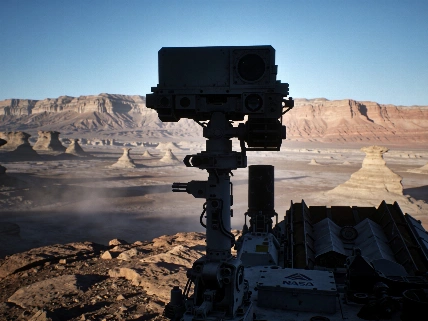
While the Webb image provides a snapshot of a cluster in the midst of assembly, it also highlights the broader context of cosmic evolution. Similar processes have shaped clusters throughout the universe's history, and ongoing observations continue to refine our understanding of how such structures form and evolve. For comparison, recent surface imaging of Mars by NASA's Perseverance rover has revealed ancient bedrock sequences at Jezero Crater, offering a planetary-scale perspective on how different cosmic environments record their histories—see the detailed view of Martian geology in this related report.
Mapping the Growth of Cosmic Structure
The Webb observation of MACS J0553.4-3342 is part of a broader effort to map the growth of structure in the universe, using gravitational lensing and high-resolution imaging to probe both the visible and dark components of galaxy clusters. The data will inform models of cluster assembly, test predictions of cosmological simulations, and help clarify the role of mergers in shaping the universe's largest bound systems.
How Gravitational Lensing Reveals Hidden Mass
Gravitational lensing is a phenomenon in which the gravity of a massive object, such as a galaxy cluster, bends and magnifies the light from more distant sources behind it. This effect, predicted by general relativity, allows astronomers to study galaxies that would otherwise be invisible and to map the distribution of mass—including dark matter—within the lensing cluster. By analyzing the shapes and positions of lensed arcs and multiple images, researchers can reconstruct the cluster's mass profile and gain insight into the physics of cosmic structure formation.