
Permafrost
2 reportsPermafrost is a climate phenomenon expressed through circulation, temperature, precipitation, feedbacks, and regional connections. Researchers test interpretations with precipitation response, observational record, and circulation pattern, while incomplete records, model assumptions, and measurement limits constrain certainty.
Reporting makes sense of Permafrost by comparing surface melt and dynamics; sea-level or carbon effects; and model uncertainty. The discussion asks what can be established from instrument records about sea-level or carbon effects and whether a compatible result appears in reanalysis products; the evidence is read with the caveat that short records, natural variability, and scenario assumptions can widen uncertainty.
Reporting makes sense of Permafrost by comparing surface melt and dynamics; sea-level or carbon effects; and model uncertainty. The discussion asks what can be established from instrument records about sea-level or carbon effects and whether a compatible result appears in reanalysis products; the evidence is read with the caveat that short records, natural variability, and scenario assumptions can widen uncertainty.
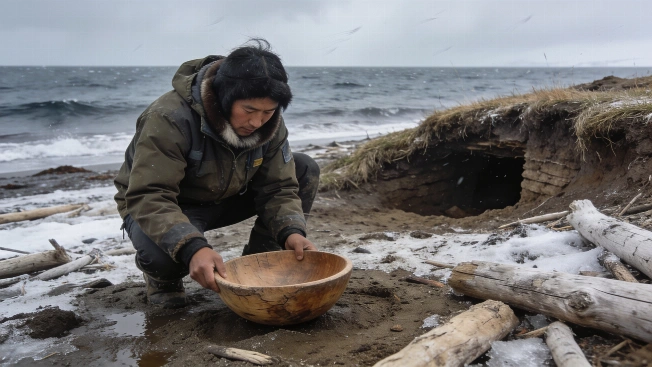
Storm Erosion Exposes Yup'ik Heritage at Nunalleq
After Typhoon Halong damaged western Alaska, archaeologists and Quinhagak volunteers carried out an emergency 2026 excavation at Nunalleq, recovering hundreds of Yup'ik artefacts before further storms and coastal erosion can carry them into the Bering Sea.
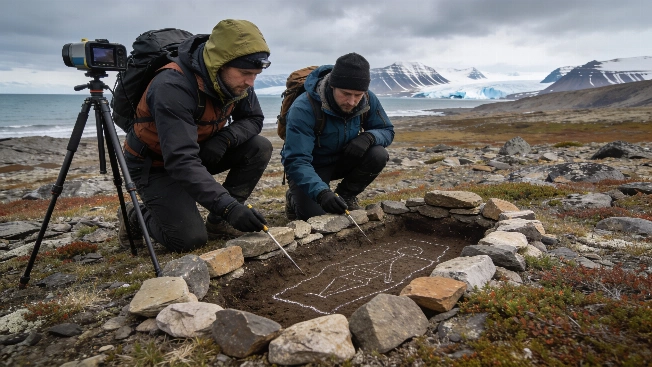
Stone-Lined Graves and Ship Timbers Documented in Arctic Svalbard Survey
Archaeologists have identified 45 stone-lined graves and ship timber fragments on Svalbard using non-invasive survey methods, raising new questions about burial traditions and the preservation of Arctic heritage under threat from erosion