After Typhoon Halong damaged western Alaska, archaeologists and Quinhagak volunteers carried out an emergency 2026 excavation at Nunalleq, recovering hundreds of Yup'ik artefacts before further storms and coastal erosion can carry them into the Bering Sea.
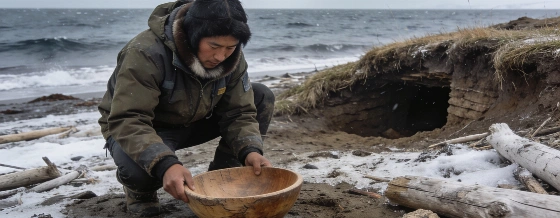
A smooth wooden bowl found on a beach in Quinhagak has become a marker of a much larger loss. The object is believed to have been carved by local residents 400 to 600 years ago and was among thousands of Yup'ik artefacts exposed or displaced after storm-driven flooding struck the nearby Nunalleq site.
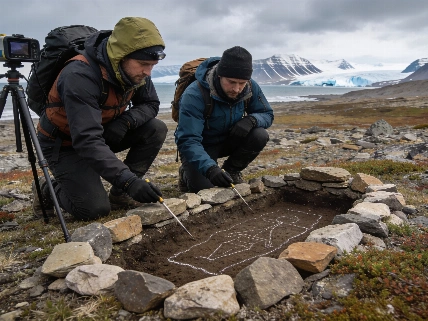
Archaeologists and local volunteers are now working against coastal erosion rather than simply excavating at a fixed site. Another severe storm could carry more objects into the Bering Sea or bury them beyond recovery. In the words of lead archaeologist Rick Knecht, the immediate goal is to remove as many objects as possible before the next major storm.
Nunalleq lies near Quinhagak in western Alaska and is regarded as one of the best-preserved examples of pre-European Yup'ik culture in the state. For residents, the site also provides a direct connection to ancestors whose tools, clothing equipment, transport technology and household objects survived in frozen ground.
Archaeological work began in 2009 after thawing permafrost exposed large numbers of preserved materials. Finds have included hand-carved animals, wooden masks, sewing needles, grass rope and parts of kayaks. These organic objects are unusually valuable precisely because waterlogged or frozen conditions can preserve materials that would normally decay.
The site covers an area roughly equivalent to two Olympic-sized swimming pools. The current emergency excavation is concentrated in a smaller zone containing the remains of sod houses dated to approximately 400 to 500 years ago. That work is not a complete investigation of Nunalleq; it is a targeted attempt to remove material most immediately threatened by the retreating coast.
Field documentation is especially important in this setting because the scientific value of an artefact depends not only on its material and manufacture but also on its position within a house, layer or activity area. The same principle underlies careful archaeological reporting in journals such as Nature and in interdisciplinary research at institutions including MIT and Harvard: observations must remain traceable to their original context.
Remnants of Typhoon Halong reached western Alaska last October, causing widespread flooding that displaced more than 1,000 people across several remote communities. In Quinhagak, strong winds and floodwater damaged buildings and infrastructure while tearing sections of coastline apart. The federal disaster record identifies severe storms, flooding and the remnants of Typhoon Halong as part of the event; the disaster area for Alaska was approved on April 13, 2026, according to the Federal Register notice.
The extent of the archaeological damage became clear the following day when local resident Jenny Matthew and her husband traveled along the beach on four-wheelers. Matthew spotted the wooden bowl among the debris. The find showed how the storm had transformed erosion from a long-term threat into an immediate recovery problem.
During the flooding, the excavation was submerged beneath several feet of water. As the water withdrew, it carried valuable objects away from the site. At some high tides, seawater can now reach the excavation pit, and the field team has described the work as taking place immediately in front of a moving destructive force.
The regional risk has not ended. In mid-September 2026, another strong Bering Sea storm brought high surf, powerful winds and rain to western Alaska. Forecast water levels along parts of the coast were expected to reach 2 to 4 feet above the normal high-tide line, increasing the potential for renewed erosion. Nearby Kipnuk was still recovering from Typhoon Halong, which destroyed 153 homes there in October 2025.
The measurable stakes are unusually concentrated: Nunalleq contains objects dating back centuries, the active excavation covers only part of a site about two Olympic pools in area, and the latest storm followed years of thawing permafrost and declining sea ice. These environmental changes have increased western Alaska's exposure to coastal erosion, with human-caused climate change contributing to both processes.
The objects recovered from the shoreline are conserved and studied at the Nunalleq Culture and Archaeology Center. The museum-laboratory facility provides a place to store the finds and makes them accessible to descendants in Quinhagak as well as to members of the public, giving the collection a role that extends beyond archaeological analysis.
Elizabeth Church, director of Quinhagak Heritage Inc., which oversees the center and the archaeological project, has described the collection as central to how the community understands its origins and responsibilities. The appearance of ancestral objects scattered across the beach strengthened the determination to care for them and carry them into the future.
That community connection matters because Nunalleq is not merely an inventory of old objects. The artefacts document decisions about materials, manufacture and adaptation in a region where environmental conditions demanded practical innovation. They include evidence for technologies used in sewing, rope-making, transport and carving, while the frozen deposits preserve forms of material culture rarely available at comparable archaeological sites.
The emergency work also differs from projects that can rely on remote mapping before excavation. An earlier survey report described subsurface archaeology mapped with ground-penetrating radar, but Nunalleq's immediate problem is physical removal: stormwater has already moved the evidence, and the shoreline continues to approach the excavation.
Remote sensing can help identify buried structures and monitor shoreline change, much as NASA Earth-observation programmes support environmental mapping, but it cannot reconstruct every lost relationship between an artefact and its original deposit. At Nunalleq, the decisive evidence may disappear between one field visit and the next.
Recovery cannot restore every lost relationship between an artefact and its original context. An object found on the beach may remain culturally important and may still reveal how it was made, but erosion can separate it from the house, layer or activity area that would have helped archaeologists interpret its use. The storm therefore threatens both objects and the contextual information that gives them archaeological meaning.
Archaeologists hope to return for another excavation next summer, although funding is still being raised. With Alaska's autumn storm season approaching, the project faces a direct choice between rapid recovery and irreversible loss rather than a leisurely sequence of field seasons.
Permafrost is not a permanent archive. When frozen ground thaws, water, microbes and physical disturbance can begin damaging organic materials that survived for centuries. Erosion then removes the deposits in which those objects were found, while flooding can redistribute them along the shore. At Nunalleq, preservation has made the site exceptionally informative, but the same environmental system that protected the artefacts is now breaking down.
Nunalleq's significance lies in the combination of archaeological evidence and living community responsibility. The recovered objects can document Yup'ik technologies and adaptation, but they cannot be treated as detached specimens once the shoreline threatens their provenience. Protecting this site should therefore be understood as urgent cultural-heritage work: without sustained funding and continued local involvement, the next storm may destroy not only artefacts but the evidence needed to explain how they belonged together.