
Betelgeuse
2 reportsBetelgeuse is an astronomical object studied through its light, motion, composition, environment, and population context. Evidence comes from formation history, spectral type, and population distribution, and competing models remain viable when observations are sparse or indirect.
Scientific questions about Betelgeuse are framed by distance and motion; stellar evolution; and stellar spectra. The discussion asks what can be established from distance or orbit estimates about stellar evolution and whether a compatible result appears in model comparison; the strongest interpretation still recognizes that limited viewing geometry and indirect measurements can leave competing explanations.
Scientific questions about Betelgeuse are framed by distance and motion; stellar evolution; and stellar spectra. The discussion asks what can be established from distance or orbit estimates about stellar evolution and whether a compatible result appears in model comparison; the strongest interpretation still recognizes that limited viewing geometry and indirect measurements can leave competing explanations.
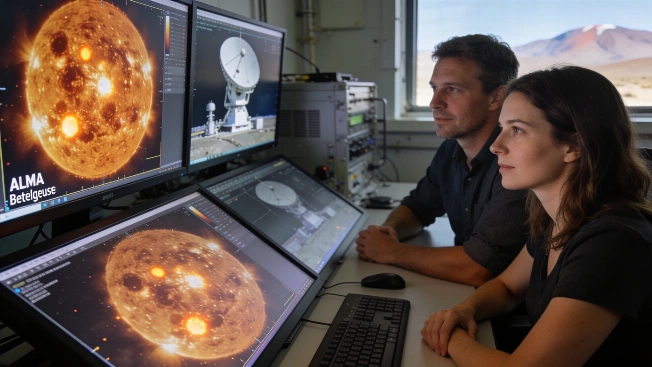
ALMA Reveals Persistent Hotspots on Betelgeuse's Turbulent Surface
Astronomers using the Atacama Large Millimeter/submillimeter Array have mapped Betelgeuse's surface in unprecedented detail, revealing long-lived hotspots and complex plasma flows that challenge current models of red supergiant stars
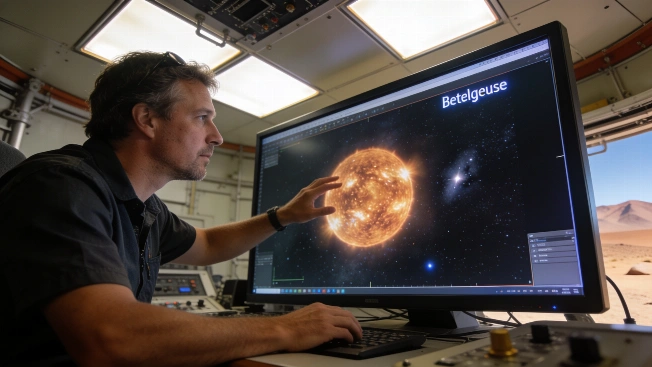
VLT Reveals Strongest Evidence Yet for Betelgeuse's Companion Star
Astronomers using the Very Large Telescope have obtained the clearest direct image to date of a faint companion star near Betelgeuse, advancing a century-long search for evidence that the red supergiant is part of a binary system