Astronomers using the Atacama Large Millimeter/submillimeter Array have mapped Betelgeuse's surface in unprecedented detail, revealing long-lived hotspots and complex plasma flows that challenge current models of red supergiant stars
Betelgeuse, one of the most prominent red supergiant stars in the night sky, has been observed in remarkable detail by astronomers using the Atacama Large Millimeter/submillimeter Array (ALMA). The new observations provide a direct look at the star's dynamic surface, revealing persistent regions of intense heat and a complex, uneven structure that defies previous expectations for such evolved stars.
Mapping Betelgeuse's Surface
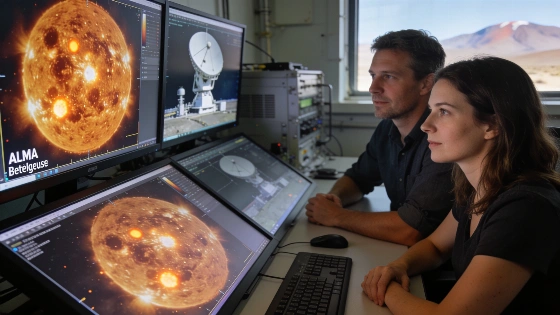
The ALMA array, operating at millimeter and submillimeter wavelengths, is uniquely suited to probe the outer layers of cool, massive stars like Betelgeuse. In 2023, researchers captured high-resolution images of the star's disk, resolving bright hotspots and a mottled, corrugated texture across its surface. These features are interpreted as evidence of large-scale convective motions-hot plasma rising and falling through the star's extended atmosphere, generating shockwaves and localized heating.
Betelgeuse is located approximately 600 light-years from Earth and is estimated to have a mass about 20 times that of the Sun. Its outer envelope is so distended that the star's diameter is roughly 800 times greater than the Sun's, making it one of the largest visible stars. The ALMA data show that the average temperature of Betelgeuse's atmosphere is around 2,030 degrees Celsius (3,680 degrees Fahrenheit), but at least two regions are significantly hotter. One hotspot, in particular, was measured to be about 530 degrees Celsius (980 degrees Fahrenheit) above the surrounding plasma.
Unexpected Longevity of Surface Features
One of the most surprising findings from the ALMA campaign is the persistence of a bright hotspot in the northeast quadrant of Betelgeuse's disk. By comparing the 2023 images with archival ALMA data from 2015, astronomers determined that this feature has remained in place for at least seven years-far longer than predicted by current models of red supergiant convection, which typically expect such structures to evolve on much shorter timescales.
This longevity suggests that some surface features on Betelgeuse may be stabilized by mechanisms not fully captured in existing simulations. The orientation and stability of the hotspots have also led researchers to consider the possibility that Betelgeuse is orbited by a faint companion star, which could influence the dynamics of its outer layers. However, direct evidence for such a companion remains elusive.
Implications for Stellar Evolution
The detailed mapping of Betelgeuse's surface provides new constraints on how massive stars lose mass and evolve in their final stages before exploding as supernovae. The observed hotspots and irregularities indicate that mass loss from red supergiants may be more structured and episodic than previously thought, with localized outflows driven by intense convective activity.
These findings are particularly relevant as Betelgeuse continues to attract attention for its dramatic variability. In recent years, the star underwent a rapid dimming event that prompted speculation about an imminent supernova, though subsequent studies have shown that such an explosion is not expected in the immediate future. The new ALMA results add to a growing body of evidence that the late stages of massive star evolution are more complex than simple models suggest. For comparison, recent observations of ancient star clusters and stellar birth in the Corona Australis region, as reported in a previous Science Report article, highlight the diversity of stellar environments and evolutionary pathways across the galaxy.
Ongoing Monitoring and Future Prospects
The research team plans to continue monitoring Betelgeuse with ALMA and other observatories to track the evolution of its surface features and to better understand the mechanisms driving its variability and mass loss. The latest study has been accepted for publication in Astronomy & Astrophysics and is available as a preprint on arXiv, providing the community with new data to refine models of red supergiant behavior.
As Betelgeuse approaches the end of its life, ongoing observations will be crucial for testing theories of stellar structure and for anticipating the processes that lead to supernova explosions. The star's proximity and size make it an ideal laboratory for studying the late evolutionary stages of massive stars in detail.
Understanding how astronomers image the surfaces of distant stars requires specialized techniques. ALMA operates at millimeter and submillimeter wavelengths, which are sensitive to the cool, extended atmospheres of red supergiants. By combining signals from multiple antennas spread over large distances, ALMA achieves the angular resolution needed to resolve features on Betelgeuse's disk. These observations are not conventional photographs but are reconstructed from interferometric data, allowing scientists to map temperature variations and surface structures that would otherwise remain invisible. Such methods are essential for probing the physical processes shaping the lives and deaths of the most massive stars in our galaxy.