
Atacama Large Millimeter Array
6 reportsThe account of Atacama Large Millimeter Array moves between archive access, while also considering operating constraints and carefully chosen site. The account compares the signal in raw and calibrated measurements with the context supplied by technical performance records when discussing operating constraints; weather, detector limits, and target selection can shape the available record.
Youngest exoplanet yet found emerges from archival telescope data
Astronomers have identified Elias 2-24 b, the youngest known exoplanet, using direct imaging techniques and archival data from the Keck Observatory. The planet is less than a million years old and still sits within its birth disk.
ALMA reveals chaotic birth of massive binary stars in real time
Astronomers using ALMA have reconstructed the formation of a massive binary star system just 5,300 light-years away, finding evidence that the two stars joined forces only decades ago rather than forming together
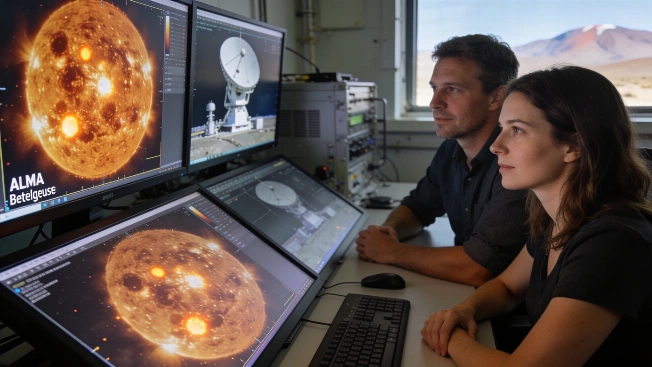
ALMA Reveals Persistent Hotspots on Betelgeuse's Turbulent Surface
Astronomers using the Atacama Large Millimeter/submillimeter Array have mapped Betelgeuse's surface in unprecedented detail, revealing long-lived hotspots and complex plasma flows that challenge current models of red supergiant stars
Trillion-Mile Gas Streamer Tilts Planet-Forming Disk in GW Orionis
Astronomers using ALMA have observed a massive gas streamer disrupting the planet-forming disk around the young triple-star system GW Orionis, offering new insight into the origins of misaligned planetary orbits

Webb Telescope Resolves Closest Black Hole Pair in Early Universe
Astronomers using the James Webb Space Telescope and ALMA have identified two supermassive black holes just 4,900 light-years apart in a galaxy merger 1.3 billion years after the Big Bang, offering new insight into rapid black hole growth
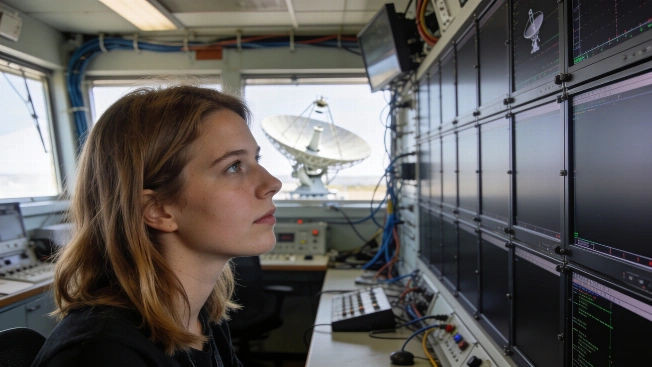
Radio Surveys Reveal Millions More Milky Way Stars Searched for SETI
A new analysis using the Besançon Galactic Model suggests that radio telescopes have surveyed over 6 million stars for extraterrestrial signals, far exceeding previous estimates based on star catalogues