At 4.5 K researchers used light to initialize and read individual molecular spins, with coherence reaching 2.2 ms under dynamical decoupling. Chip integration remains a development goal
At 4.5 K, a focused laser can trigger the formation of stationary electron-spin qubits inside an organic crystal. Researchers used synthetic carbene molecules to control individual spins coherently and read them through emitted light, demonstrating a molecular route to a spin-photon interface. The peer-reviewed Nature study, "A Single-Molecule Spin-Photon Interface," describes work by NVision Imaging Technologies GmbH with collaborators at Ulm University and The Hebrew University of Jerusalem. NVision screened more than 150 candidate molecules and synthesized 40 before selecting the carbene system.
Inside the Molecule
The carbene is a divalent carbon unit bound to aromatic biphenyl rings. Researchers embed it in a structurally matching organic host crystal, then use a focused laser to remove nitrogen from a precursor compound and create individual qubits. The study was conducted by NVision Imaging Technologies GmbH with collaborators at Ulm University; The Hebrew University of Jerusalem also contributed.
The spin's internal energy splittings help shield it from magnetic noise associated with nearby hydrogen atoms. The reported zero-field splitting parameters are |D| = 11.16 GHz and |E| = 0.54 GHz. These measurements describe the molecular system under the reported cryogenic conditions; they do not establish that the qubits will retain the same performance in an integrated chip.
Reading One Spin
Light at 595.04 nm lets researchers initialize and read a single electron spin through a zero-phonon line. Measurements with single-photon detectors produced an antibunching dip of g(2)(0) = 0.142, indicating that the optical signal came from individual molecular emitters. The reported result demonstrates optical control and readout of molecular spins at cryogenic temperatures.
Pulsed microwave control extended coherence to 2.2 ms when researchers applied dynamical decoupling sequences. That is a measured coherence result for the experiment, not a demonstration of a logical qubit or a working quantum processor. The study demonstrates a platform for connecting stationary molecular spins to photons; it does not report entangling gates between separate molecular spins.
Chip Integration Remains
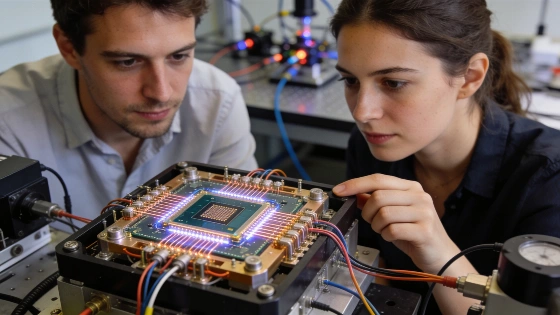
NVision's partnership with HyperLight Corporation is aimed at depositing carbene thin films directly onto HyperLight's thin-film lithium-niobate TFLN Chiplet photonic platform. The planned architecture would route emitted photons through on-chip waveguides, allowing separate qubits to connect optically. NVision describes organic molecules as solution-processable materials that can be deposited as thin films, offering a potential alternative to semiconductor color centers made through cleanroom fabrication.
The companies expect to produce their first prototype integrated chips in the fourth quarter of 2026, information from NVision's announcement. The chiplet integration is a development plan, not the result demonstrated in the Nature experiment. The architecture is described as able to tolerate up to 70% optical loss, though the supplied account does not specify the conditions behind that figure. Uniform film deposition across large wafers and low-loss coupling between molecules and waveguides remain engineering tasks, alongside demonstrating high-fidelity entangling gates between distinct qubits.
The distinction between a hardware plan and a demonstrated capability also matters in the Helios simulation plans, which concerned trapped-ion simulations rather than molecular-spin chip integration. NVision is targeting an on-chip prototype by the end of 2026, while its roadmap aims for fault-tolerant logical systems by 2030. Both are targets, not completed milestones.