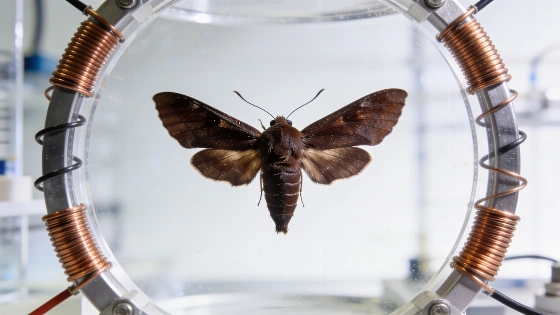
By reversing the geomagnetic field around tethered moths in a flight arena researchers found that the insects changed direction accordingly, evidence that their nocturnal navigation combines magnetic and stellar cues
Each summer, approximately four billion Bogong moths fly more than 1000 km through darkness to reach caves in Australia's Snowy Mountains. The insects find these sites without having visited them before.
A Magnetic Turn
Researchers captured moths and tethered them in a flight arena surrounded by magnetic coils. The coils let the team manipulate Earth's magnetic field while recording the insects' flight direction. The arena's full-spectrum starry display was randomized to remove directional information from the stars while retaining naturalistic illumination. When the magnetic field's orientation was rotated by 180 degrees or its inclination was inverted, the moths flew in the opposite direction. Changing magnetic polarity alone did not produce the same response.
The results demonstrate that the geomagnetic field can guide Bogong moths in their inherited migratory direction when the star display supplies no directional cue. A Lund University-led team, including Hui Chen, Lina Rosberg and Daniel Dreyer, published the study in Nature on 18 November 2026. The paper, published in Nature (doi:10.1038/s41586-026-11322-9), identifies the magnetic compass as light-dependent and consistent with a radical-pair sensing process.
Reading Inclination
The moths respond to magnetic inclination: the angle between Earth's magnetic field and the ground, rather than simply the field's north-south polarity. In the account given by the researchers, this angle increases as the moth moves south and decreases as it moves north, providing information about direction. Removing violet-blue light wavelengths between 380 and 500 nanometres abolished magnetic orientation; weak broadband radio-frequency fields between 150 kHz and 60 MHz did so as well. These findings support a radical-pair explanation, while the sensory organ and molecular pathway remain to be identified.
A magnetic compass can complement the star compass identified in 2025. The two cues give the moths independent ways to orient themselves during nocturnal migration, including when clouds obscure the stars. Eric Warrant and colleagues have noted that the moths can navigate towards their distant goal using the stars and maintain their course when stars are hidden. Earth-field measurements also feature in engineered navigation; a separate report on magnetic navigation systems describes an aircraft-oriented sensor, a distinct application from the moths' biological compass.
Mechanism Still Unknown
Lund University zoologist Eric Warrant, who has a background in physics, has pointed to the shared magnetic-sensing principle in birds and insects as a possible ancient mechanism conserved through evolution. Hui Chen described the result as a navigational ability reminiscent of that found in migratory birds, while noting that insects and birds evolved along separate paths for around 700 million years. The finding does not establish that the groups use identical anatomical structures or identify how the moth's compass works.
The experiment demonstrates directional sensing in a controlled flight arena rather than every step of a free migration. The research team's stated next step is to investigate how the light-dependent magnetic system is detected and how it interacts with the moths' other senses. Lund University has summarized the study as evidence that the moths use two internal compasses to navigate.