

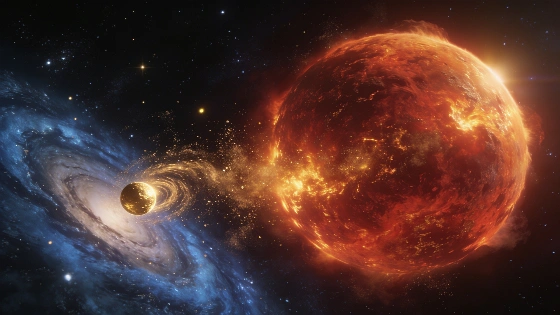
Webb's mid-infrared observations captured the aftermath of a 2025 eruption in Andromeda, helping researchers combine telescope data to trace how a low-mass companion spiraled into a swollen supergiant
The smaller star completed just seven orbits after it began grazing the surface of its swollen companion. The pair then merged, with the smaller star dragged into the giant's core.
Researchers reconstructed the event using observations gathered as it unfolded and later mid-infrared data from NASA's James Webb Space Telescope. The system, formally known as AT 2025abao, is nicknamed Bao. The team's observations traced the system from its relatively quiet phase through contact, inspiral, eruption and the aftermath-stages rarely observed together in a common-envelope event.
Seven Orbits
The two stars had orbited one another for millennia. Once the smaller companion began interacting with the giant's outer surface, the final phase lasted about seven years-roughly seven orbits. Other known mergers involving smaller stars took place after thousands of orbits.
The giant, called Big Bao, was estimated at seven times the Sun's mass, 350 times its radius and 18,000 times its brightness. Researchers' modeling produced the first mass estimate for the companion, Little Bao: about 0.7 solar masses. Those figures are model-based estimates, not direct measurements of the stars' masses. The Nature study identifies the primary as an approximately seven-solar-mass asymptotic giant branch star.
Following the Eruption
The team first flagged Bao in February 2023 in data from NASA's retired NEOWISE mission, after the object showed unusual variability. Before 2018, it had maintained a consistent luminosity. Observations by the Wide-field Infrared Transient Explorer in September 2024 showed that it was brightening and shedding dust.
NASA's SPHEREx recorded a rapid fading in visible light alongside an infrared brightening during a routine survey in July 2025. The Zwicky Transient Facility detected the eruption on Oct. 17, 2025, as the stars brightened sharply. Webb observed the system on Dec. 24, 47 days after the eruption peaked-the earliest follow-up of this kind of event reported by the researchers.
Webb's mid-infrared data helped the team characterize dust shed by Big Bao over centuries, as well as material produced in the roughly two months after the eruption. Webb's infrared view of dust also features in a related Webb dust report, which covered a pillar in the Carina Nebula rather than a stellar merger.
Inside the Envelope
As the companion moved through the giant's outer layers, drag robbed it of orbital energy and pulled it inward. The shared gas surrounding both stars is known as a common envelope. In some binary systems, both stars survive this phase in a much tighter orbit; in Bao, the team's analysis indicated that Little Bao reached Big Bao's core.
The researchers updated simulations to find a model that matched Webb's observations. The modeling initially allowed for the possibility that Little Bao could escape with leftover energy, but further analysis pointed to its plunge into the core. The Nature paper reports that the merger ejected the outermost 10% of the giant's envelope at speeds about 10 times the primary star's escape speed. The team used the outflow to constrain the common-envelope efficiency parameter, alpha, to a range of approximately 0.01 to 0.4. The paper describes alpha as the fraction of dissipated orbital energy available to unbind the convective envelope.
A common envelope begins when a star expands far enough to engulf its companion. The companion's motion through the shared gas creates drag, which can shrink its orbit and transfer energy to the surrounding material. Whether the stars merge or emerge as a surviving pair depends on how that interaction unfolds. Common-envelope evolution is expected to shape many close binary systems, but its rapid, embedded stages are rarely observed directly.
What Webb Established
Webb's observations helped establish that the stars merged and allowed the team to estimate how much mass the system expelled. The broader reconstruction drew on observations from several telescopes, including data collected before the eruption. It provides a way to study common-envelope evolution while the event is unfolding, rather than inferring it from a system long after the process has ended.
The researchers' observations of AT 2025abao span the pre-eruption system, the stars' interaction and inspiral, the 2025 outburst and the post-eruption period. The resulting measurements provide an observational benchmark for models of how orbital energy is transferred into a giant star's envelope and how that envelope is expelled.







