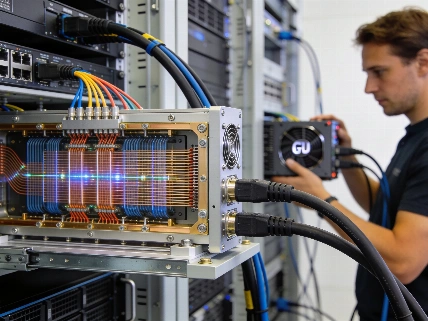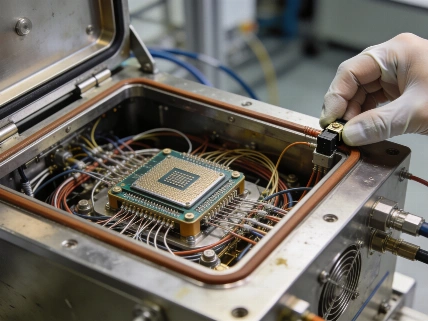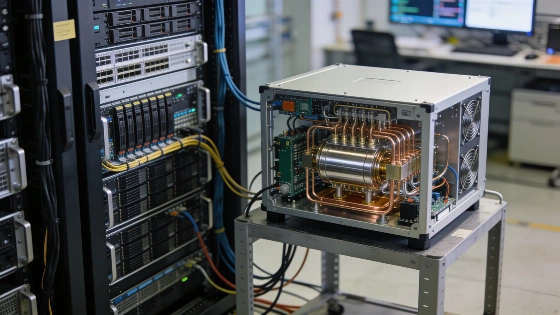
IQM's Halocene program calls for commissioning each new processor beside the system it replaces, with the goal of keeping active HPC workloads running during hardware upgrades
The next Halocene processor would be installed and commissioned alongside the existing machine, which would remain in place until the replacement is ready. IQM says this staged handover is designed to let HPC centres increase capacity without interrupting active workloads.
Staged replacement
IQM Quantum Computers announced the on-premises program in Chicago on November 17, 2026, at SC26. Halocene, introduced by the company in November 2025 with a 150-qubit system, is described as an error-correction product line. The upgrade program sets out a route from that starting configuration to future systems exceeding 1,000 qubits-more than 6.67 times the initial qubit count. IQM says customers can move through successive systems while continuing hybrid workloads alongside AI and HPC systems.
The announced figures refer to processor qubit capacity. IQM has not provided logical-qubit specifications for the 1,000-plus-qubit system, so the announcement does not establish how many error-corrected logical qubits it would support or what computations it could run. The company has not disclosed a delivery date for that future system.
HPC integration
Each transition includes IQM's HPC integration service. The stated plan is to maintain continuity across software toolchains and Slurm-based HPC job schedulers, with GPU interconnects also included. The modular error-correction stack is integrated with NVIDIA CUDA-Q Logical and uses real-time QEC decoding over NVIDIA NVQLink. The architecture is intended to connect local quantum processors with existing CPU and GPU clusters for hybrid AI and simulation workloads while keeping data on site.
This is a deployment plan, not a reported test of uninterrupted operation during an upgrade. The company's earlier commercial reporting provides separate business context; it does not verify the performance of this migration model. IQM's official announcement also describes integration with customers' existing HPC environments, schedulers and GPU platforms.
Deployment record
IQM says it has completed 10 supercomputing integrations since 2021. Its examples include upgrades at Finland's VTT, from 5 to 53 qubits, and four systems at Germany's Leibniz Supercomputing Centre (LRZ), including Euro-Q-Exa.
The Halocene roadmap was first introduced in November 2025 and selected by the LUMI AI Factory, coordinated by CSC - IT Center for Science, for the LUMI-IQ superconducting system. IQM says LUMI-IQ is intended to connect to the forthcoming LUMI-AI supercomputer for hybrid HPC and AI workloads. The company's announcement does not give a target delivery date or logical-qubit specifications for systems exceeding 1,000 qubits.