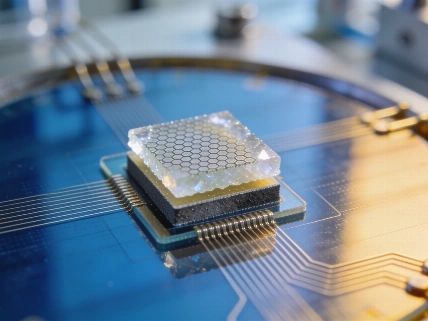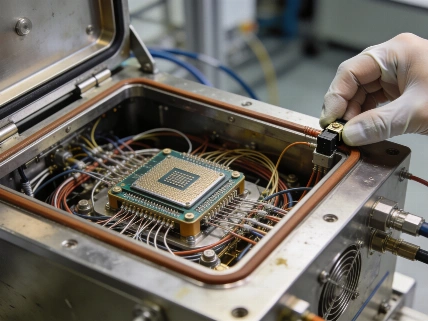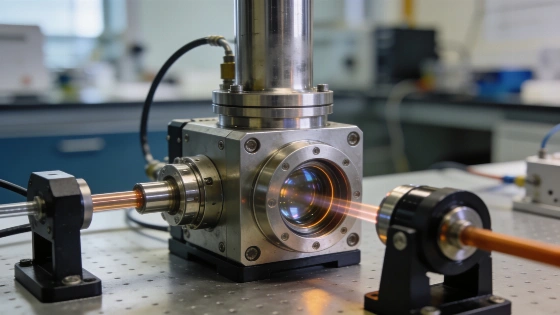
Quantinuum and GE Vernova plan to run Fermi-Hubbard simulations on the Helios quantum computer, testing whether simulated pairing states can inform the search for high-temperature superconducting materials
High-temperature superconductors can carry current without electrical resistance at temperatures accessible with liquid nitrogen, but the mechanisms behind their behaviour remain difficult to model. On October 27, 2026, Quantinuum and GE Vernova's Advanced Research Center announced a collaboration to apply quantum computing to the problem. The program will use Quantinuum's Helios trapped-ion quantum computer to study electron behaviour associated with high-temperature superconductivity.
What Helios will model
The planned work centres on the Fermi-Hubbard model, a theoretical structure for studying interacting electrons on a lattice and the complex properties that emerge from those interactions. It is a model for investigating pairing behaviour, not a direct simulation of a particular commercial superconductor. The team will use Helios through Quantinuum's cloud-based Nexus developer platform, which connects quantum hardware with tools for developing and running applications.
GE Vernova contributes materials science, engineering and industrial-application expertise, while Quantinuum supplies quantum hardware and software capabilities. The research is intended to connect basic quantum simulation with questions relevant to energy equipment. The companies point to potential long-term applications including lighter generators, more compact and powerful motors, and electricity infrastructure with greater power-carrying capacity and fault tolerance.
Quantinuum says the collaboration builds on earlier Helios experiments in which its researchers measured s-wave and d-wave superconducting pairing correlations in Fermi-Hubbard models. These correlations are signatures within a theoretical model; they are not evidence that a practical superconductor has been created or identified. The work will examine whether simulated pairing states can inform the search for material compositions that operate at less demanding cooling temperatures.
From algorithms to hardware
GE Vernova ARC has previously benchmarked variational quantum algorithms for carbon-capture materials using GPU-accelerated state-vector simulators. The new program moves the work onto physical quantum hardware. GE Vernova has described the collaboration as a way to combine its materials simulation and industrial expertise with Quantinuum's quantum-computing capabilities.
The earlier pairing measurements provide context for the collaboration's focus. They concern quantum states prepared and probed in Fermi-Hubbard models, rather than a measured operating temperature for a real-world material. A separate hardware analysis examined the distinction between processor metrics and progress in error correction on atom-array systems; it concerns a different platform and research question.
What remains unshown
Strong electron correlations challenge conventional computational approaches, including Density Functional Theory and mean-field approximations. Classical methods also face scaling difficulties for two-dimensional Fermi-Hubbard lattices. The size and performance of a quantum simulation matter: a comparison with classical calculations would help characterize what Helios can accomplish on the model.
Superconducting materials could be relevant to grid equipment and propulsion, where conventional conductors bring resistance, heat and weight constraints. Those are potential application areas for future materials research, not reported outcomes of this collaboration. The program's immediate focus is modeling interacting electrons and pairing correlations on Helios, rather than launching a material or a grid deployment.
Quantinuum's announcement describes the research objective and the planned use of Helios and Nexus. It does not report a new simulation result, a discovered material or a demonstrated operating temperature. The company's collaboration announcement presents the project as research into the behaviour behind high-temperature superconductivity.