Alice & Bob's Carbon design links nine cryogenic modules and targets 200 logical qubits from 3,600 physical cat qubits. The company's longer plan extends to 2,048 logical qubits in 2034
Nine linked modules are central to Alice & Bob's planned Carbon system, which is specified to occupy 350 square meters and connect separate quantum chips. The Paris- and Boston-based company is targeting 200 logical qubits from 3,600 physical cat qubits by 2030; this is a roadmap goal, not a reported delivery. In its November 18, 2026 announcement, the company described the target as double its previous 2030 goal and presented Carbon as a utility-scale system for materials-science simulations, including Ising and Hubbard models. The company's announcement sets out milestones through 2034.
The architecture relies on cat qubits that autonomously suppress bit-flip errors at the hardware level. Alice & Bob says this lets its error-correction design concentrate primarily on phase-flip errors, reducing the physical-qubit overhead it expects to need for fault tolerance. That design rationale does not itself demonstrate a fault-tolerant system.
Milestones on the roadmap
The roadmap begins with Helium, a 2026 logical-qubit prototype. The next stage, Beryllium, is scheduled for 2028 and targets six logical qubits in a single module, alongside universal quantum operations across a complete gate set. Carbon is the planned 2030 utility-scale stage, with nine linked modules and 200 logical qubits. The next targets are 1,024 logical qubits in 2032 and 2,048 in the 2034 Neon system, using 25 and 56 modules respectively.
The planned applications also grow with the systems: the 2030 design is intended to enable Ising and Hubbard materials simulations, while the 2032 stage is associated with initial Shor algorithm implementations and FeMoCo chemistry. The 2034 roadmap lists RSA-2048 and Bitcoin cryptographic stress testing alongside materials modeling. Alice & Bob also identifies chemistry and energy as later-stage application areas. These are projected capabilities, not results demonstrated by the systems described in the roadmap.
What Carbon requires
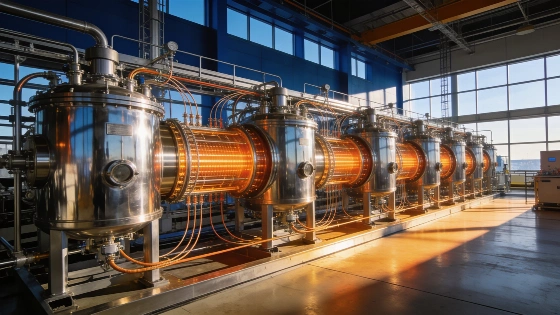
Technical specifications describe nine dilution refrigerators linked by cryogenic coaxial cables, with Bell-pair exchange between chips intended to preserve quantum states. Each of Carbon's nine modules is described as containing 400 physical cat qubits, totaling 3,600. The design calls for degree-five qubit connectivity and a hybrid low-density parity-check and repetition code. It also lists a 10-microsecond clock speed, 10 million logical operations and a target logical error rate of 10-7.
Moving from modules to a combined system requires entangled-pair exchange between processors, cryogenic links that preserve quantum information, and coordinated calibration, compilation and decoding across modules. Those specifications describe the intended architecture; the supplied material does not report a completed Carbon system or measured performance against those targets. The difference matters: a roadmap's logical-qubit count and error-rate goal cannot establish that the hardware has achieved them.
Hardware behind the plan
Alice & Bob says the accelerated schedule builds on work in France's PROQCIMA program, where it fabricated, assembled and operated three independent quantum processors and demonstrated core logical-qubit building blocks near the error-correction threshold. An earlier PROQCIMA report covered the company's demonstrators; the new roadmap presents those efforts as a foundation for its larger modular system.
The company also cites AI-assisted chip design and algorithmic optimizations that it says cut estimated RSA-2048 resource requirements by a factor of 40. Its modular, multi-cryostat approach is intended to avoid the limits of scaling within a single refrigerator through standardized QPU manufacturing. The roadmap does not provide a completed system-level demonstration of that scaling approach.