SAXON Q says Quantum Watchdog would track physical telemetry and insert verified calculations during live workloads, with up to 50% of runtime available for checks; initial custom implementations are slated for early 2027
Quantum error correction addresses stochastic qubit noise; physical degradation and environmental drift call for a separate monitoring layer. SAXON Q says its Quantum Watchdog architecture is designed to provide that layer while processors run active workloads. Announced in Leipzig on November 17, 2026, the system is described by the company as a patented safety layer that can detect failures during operation and move affected systems into a safe mode. The announcement was reported by HPCwire.
Monitoring the hardware
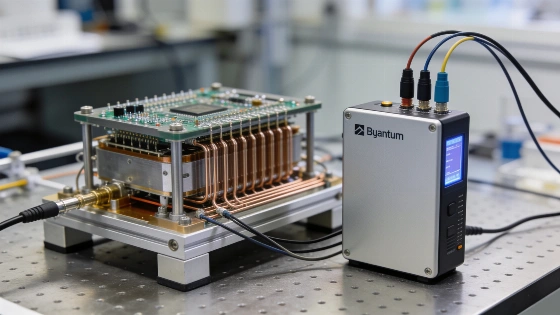
The system would use an independent classical processor with isolated timing hardware, its own clock and timers, and environmental sensors. It tracks power draw and temperature. Separate sensing covers ambient magnetic fields, with the aim of detecting physical failures or signs of tampering. SAXON Q says the independent architecture is designed to supervise the machine rather than depend solely on the quantum processor's control stack.
The distinction matters: the company describes Quantum Watchdog as a complement to quantum error correction, not a replacement for it. The system targets hardware conditions that error-correction routines focused on qubit noise are not designed to monitor. Its announced applications include edge deployments in defense and robotics; automotive environments are also in scope, alongside multi-processor high-performance computing clusters. SAXON Q also presents the system for laboratory and field use, and says it is intended to work across superconducting, trapped-ion and other qubit platforms, as well as quantum-sensing systems.
Checks during workloads
Quantum Watchdog would periodically insert verified test calculations into user workloads. The firmware is described as containing a library of test problems with known answers and statistical thresholds for identifying operation outside preset parameters. Depending on how critical an operation is, users could assign up to 50% of processor runtime to diagnostic verification. Alternatively, checks could run at startup and at intervals during operation.
This creates a trade-off between diagnostic frequency and time available for user work. SAXON Q says the architecture can be configured for different operating requirements, but the announcement gives no detection-rate or false-alarm figures. It therefore does not establish how accurately or quickly the system would identify faults in practice. If test results exceed configured error tolerances or physical readings cross preset limits, the Watchdog can classify the condition as a failure and trigger a predefined response.
A separate processor connectivity report covered how local hardware connections shaped a quantum workload; Quantum Watchdog instead focuses on monitoring processor conditions.
Multi-processor safeguards
For multi-core systems, the design offers comparison between two processors or majority voting across three or more. The stated aim is to isolate and shut down a malfunctioning unit without stopping the rest of the cluster. The announcement describes this as an architectural capability; it does not provide a field-test result showing uninterrupted operation during a fault.
SAXON Q describes the system as hardware-agnostic and says it is compatible with superconducting processors. The company also names trapped-ion hardware and quantum-sensing systems. Its first planned configurations are for the room-temperature SXQ128 and SXQ512 multi-core processors, using an onboard control circuit for safety monitoring. Each implementation is to be custom-built around the customer's monitoring requirements.
Implementation plans
SAXON Q says patents for the architecture have been granted in Europe, the United States and China. The company is offering licenses to quantum-hardware manufacturers, original equipment manufacturers and system integrators. Initial custom implementations are slated for early 2027, with deployments available on request.
Formally safety-certified versions are scheduled to follow independent auditing and field testing. The announcement presents a development and licensing plan; it does not report a completed audit or safety certification.