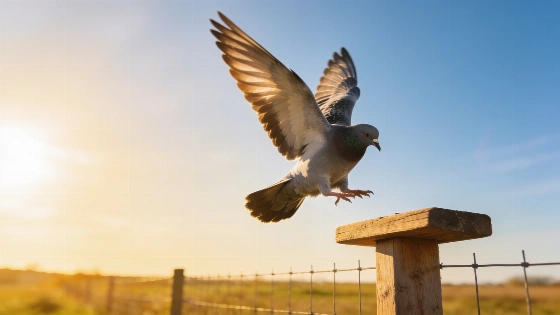
A control-theory model finds that a pigeon could stop at a raised perch without flapping, but only after building speed and covering about 60 metres horizontally
As a bird slows on its final approach, its wings lose the airflow needed to generate steering forces. That creates a landing dilemma: arriving slowly is desirable, yet too little airspeed leaves the bird with less control. As co-author Ben Parslew put it, flying animals and aircraft use airspeed not only for lift but also for control.
The Perch Approach
Researchers Tom Rottier, Philippe Lavoie and Ben Parslew, affiliated with the University of Manchester and the University of Toronto, used optimal-control methods to map an ideal unpowered landing. Their study, published in Proceedings of the Royal Society A as "Flight dynamics and optimal control of unpowered avian landings," examines how a gliding bird could reach a raised perch with zero forward speed without flapping. It describes a calculated manoeuvre, not a landing routinely performed by pigeons.
The model treats the bird as a point mass subject to gravity, lift and drag, with wing angle of attack as its only control. To brake, the optimal path turns into a steep climb, with the wings approaching 90 degrees and acting primarily as air brakes. The manoeuvre must trade off low touchdown speed against the lift and steering authority that diminish as airspeed falls.
The distance is substantial. For a model pigeon weighing 400 g, the calculated approach begins from level flight at 36 m/s-about 130 km/h or 80 mph, more than twice its usual cruising speed. It would travel about 60 m horizontally while climbing roughly 20 m before stopping at the raised perch.
Why Birds Keep Moving
Real birds commonly arrive with speed remaining and absorb it through their legs; wing movements and flapping can also help them brake, particularly when the approach is short. In the model, even the slowest gliding approach to the ground ends at an angle of about 34 degrees below level, leaving residual speed at touchdown. A bird gliding down to the ground therefore cannot eliminate its speed at the last instant: the remaining energy must be absorbed by its wings, legs or both.
Parslew said the space required surprised the team, which had expected an approach of about 10 m. Remaining airspeed gives a bird aerodynamic control and can help it respond to gusts or positional errors near a perch. The researchers also noted that a very steep climb could disrupt the visual cues birds use during an approach, while obstacles in cities or forests may leave no room for the roughly 60 m trajectory.
The model points to one way to reduce the demands: doubling the wing's maximum lift coefficient cuts the required starting speed by 44% and the horizontal distance by 65%; the climb falls by about 55%. The researchers link greater maximum lift to aerodynamic changes such as pitching up and spreading the wings. Birds can also raise the alula, a small feather that acts like an aircraft wing slat.
Earlier wind-tunnel work on gliding in the pigeon Columba livia reported a best lift-to-drag ratio of about 5.5-6.0. The study found that changes in wing area and shape kept the ratio near its maximum at speeds up to at least twice the minimum gliding speed. This aerodynamic background is relevant to how lift and drag vary with speed and wing configuration, but the experiment did not test a zero-speed perch landing.
A similar distinction between measured capability and performance under other conditions appears in a multi-qubit idle-stability report, which left performance during entangling operations unresolved.
Swoops and Landing Costs
The study also reexamines work on Harris's hawks published in Nature in 2022 by Graham Taylor's group at the University of Oxford. That research proposed that swooping minimizes the distance travelled while stalled. Rottier and colleagues argue that this measure combines stall duration with landing speed: a bird moving slowly after a stall also touches down slowly.
When the two factors are separated, minimizing stall time alone produces fast arrivals that the researchers describe as harmful, with no swoop. The closest match to the hawk data comes from balancing both goals, with lower touchdown speed doing most to produce the swooping path.
Flat-ground landings impose a different limit. A gliding bird cannot climb before touching down, so it cannot shed all its speed in the air. The remaining energy must be absorbed by its wings, legs or both. Ground landings therefore usually involve flapping, unless a strong headwind helps brake the bird; water offers ducks, geese and swans a more forgiving landing surface.
Residual touchdown speed also sets a minimum requirement for leg strength and, in turn, leg mass. The researchers suggest that this trade-off between lighter legs for flight and stronger legs for landing may have influenced bird evolution. The zero-speed perch landing remains a mathematical and computational result: the team used equations for a bird gliding under gravity, lift and air resistance, rather than flight trials with live pigeons.