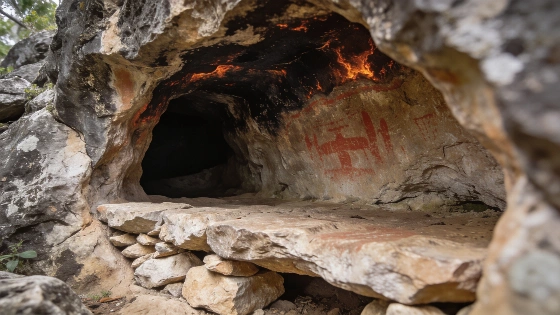
Soot above a stone shelf and red-painted signs inside Cave 19 at Chalcatzingo point to ceremonies for deceased warriors, while researchers say the possibility of cremation remains unconfirmed
A stone shelf at the rear of Cave 19 sits below rock blackened by fire. Researchers say the feature may have held an incense burner or a funerary bundle during ceremonies commemorating deceased warriors, although no surviving material confirms what was burned.
The small rock shelter lies on the western face of Cerro Delgado, about 330 meters from the center of Chalcatzingo in Morelos, Mexico. Its painted signs are dated broadly to the fourth through sixth centuries AD and are associated with a writing tradition linked to Teotihuacan, according to an Antiquity study.
Signs in the Cave
A survey in August 2022 used digital photography and image improvement to document three groups of dark-red paintings. The first combines stylized mountains with scroll-like forms emerging from an open mouth. Researchers interpret the imagery as a place name meaning "Singing Mountain," drawing on Teotihuacan visual conventions in which scrolls represent speech, song or vocalization.
A nearby hill was historically known by the Nahuatl name Cuicatepec, which has the same meaning. Researchers suggest the painted name may refer to Cerro Delgado, though that identification is conditional. If it is correct, the mountain's name and religious significance may have persisted for more than a millennium.
Similar references to Singing Mountain appear in Teotihuacan murals showing priests carrying incense and performing scattering rituals. These iconographic parallels inform the proposal that people from Teotihuacan may have traveled to Chalcatzingo on pilgrimage; the paintings themselves do not establish a route or prove that Teotihuacan residents made them.
A second group of signs includes a beaded necklace, cloth resembling ceremonial clothing and a dart associated with an atlatl, or spear-thrower. Researchers suggest the combination may represent a military title or a particular warrior group rather than a literal narrative scene. The images do not identify a named warrior, military unit or battle.
Fire and Commemoration
The third painting is positioned above the stone shelf. It consists of a rectangular frame decorated with five-pointed stars, a design comparable to motifs on Teotihuacan ceremonial incense burners and objects associated with commemorating dead warriors.
The shelf may have supported an incense burner or a funerary bundle while a fire burned in the cave. Researchers raise cremation as one possible part of the ceremonies, but the soot and paintings do not identify the material burned or establish that cremation took place.
The shelter measures 5.43 meters across and extends about 2.24 meters into the rock, covering roughly 7.4 square meters. Reaching it is difficult: researchers approach from the opposite side of the mountain and descend the western escarpment. Carved footholds and rudimentary steps suggest people had made parts of the terrain easier to navigate; visitors may also have used scaffold-like ladders.
A Longer Sacred History
Chalcatzingo is best known for Olmec-style monuments dating to around 900-500 BC. Earlier carvings at the site depict caves, rain clouds, supernatural beings and maize. The later paintings represent another phase of activity at a place with much older ceremonial associations.
During the 2022 survey, archaeologists also recorded scattered pottery fragments and part of a stone grinding implement. The wider region contains evidence of Teotihuacan influence: at San Ignacio, about 13 kilometers south of Chalcatzingo, pottery, architecture and ceremonial objects point to a substantial Teotihuacan presence. Researchers suggest Chalcatzingo had particular religious significance, while some other settlements may have served economic or strategic purposes.
The cave paintings add evidence that Teotihuacan-style writing was used beyond the city itself. The wider corpus contains nearly 120 signs interpreted as place names, personal names, titles, calendar information and actions. For another account of a cave-art study, Science Report covered paintings at Tangbaletasi, a separate site in the Altai Mountains.
The signs and fire-blackened rock support an interpretation of ritual activity connected with warrior commemoration. The researchers' proposal that some ceremonies involved cremation remains tentative because no surviving material confirms what was burned.