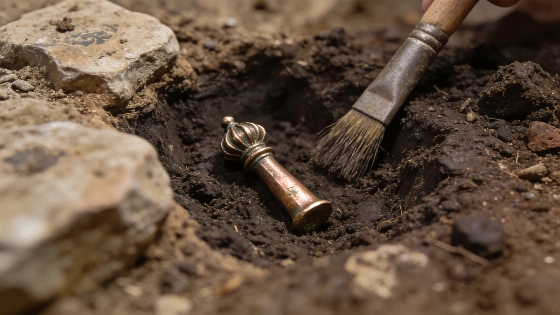
Excavations at a medieval settlement in southern Armenia recovered a copper fitting interpreted as part of a scepter. Its context adds material evidence to the history of Kapan as a center of royal power
Old Kapan is identified with a settlement in the southern part of modern Kapan, on the right bank of the Voghji River. Archaeologists are excavating its remains near the former political center of the Kingdom of Syunik. The site's royal citadel and palace complex are the focus of a project begun in 2024 by Armenia's Institute of Archaeology and Ethnography, part of the National Academy of Sciences, under expedition leader Gagik Sargsyan. The Syunik Regional Administration initiated and funded the work.
The latest finds include a copper head interpreted by the excavation team as part of a scepter and a symbol of authority. Recovered during the November 2026 excavation season, the object was transferred to the Kapan Geological Museum. Its association with power is an archaeological interpretation; the fitting alone does not establish who used it or how it was displayed.
Finds from the excavation
Investigations began in 2024. The team from Armenia's Institute of Archaeology and Ethnography is led by archaeologist Gagik Sargsyan and focuses chiefly on the royal citadel and palace complex. The team identifies the site as Old Kapan, a settlement mentioned in historical sources from the 5th century onward. The excavation was initiated and funded by the Syunik Regional Administration.
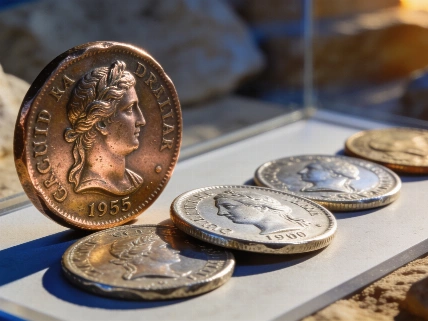
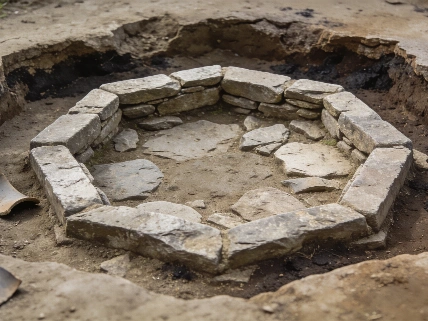
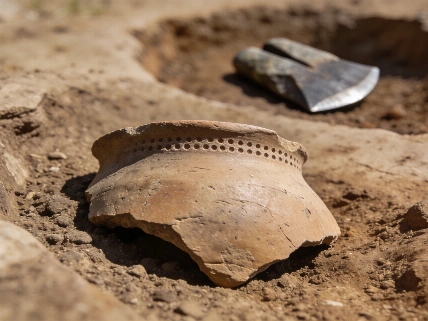
Other recovered material includes part of a cover from a parchment manuscript or scroll. Excavators also found two metal coins beneath soil, along with a fragment of medieval glass. Iron nails and rivets were recovered, as were pottery fragments assigned to the same broad period. A finely dressed-stone furnace was also identified at the edge of the archaeological site during the 2026 campaign. The excavation season was expected to conclude within days as weather conditions deteriorated.
At another excavation, archaeologists documented a reused carved stone and a relief-carved head in the Aberlemno excavation. At Kapan, as elsewhere, the context of each find is essential to interpreting its role; the reported material does not by itself establish how the objects were used.
Royal center
Kapan became a political and cultural center of the Kingdom of Syunik, founded in AD 987. Its position along the Voghji River placed it near Baghaberd, a major fortress associated with the kingdom.
In 2025, archaeologists exposed the foundations of an early medieval three-aisled basilica beneath a later palace structure and documented an olive press, whose stone component has been preserved. A finely dressed-stone furnace was reported at the edge of the site during the 2026 campaign. A polished-stone structure in the settlement has also been provisionally interpreted as a furnace that heated water for a bath. Nearby baths and service or economic buildings are possible, but their layout and dates have not been established.
The Armenian historian and bishop Stepanos Orbelian recorded that Seljuk incursions under Amir Harun destroyed Kapan in 1126. The kingdom continued from the fortified stronghold of Baghaberd and remained independent until 1170.
Trees now cover much of the archaeological site, making excavation and interpretation of its remains more difficult. In a November 2026 report, Armenpress reported that the copper fitting had been transferred to the Kapan Geological Museum. The excavation team's identification of it as a possible scepter component adds an object associated with authority to the material recovered from the former royal center.