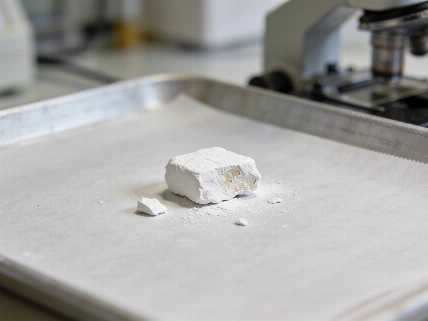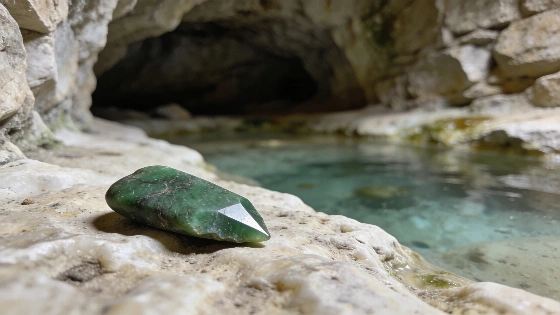
Microscopic analysis identified the polished tool as eclogite from the western Alps. Its unworn edge and find beside a Neolithic thermal spring are consistent with deliberate symbolic deposition, though they do not establish how it was placed there.
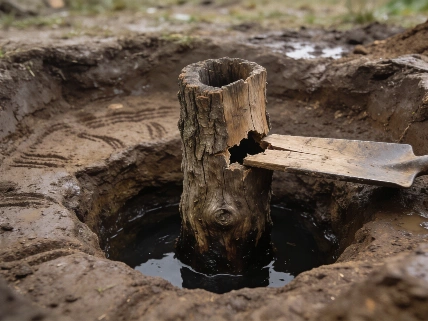
A thermal spring emerges from the rock inside a travertine cave at Terme di Sorano, where excavations cover about 320 square metres. On 16 November 2026, during the site's third excavation campaign, archaeologists uncovered an intact, polished greenstone axe in the prehistoric cavity, hundreds of kilometres from western Alpine sources of its stone. The excavation began in July 2024 under a concession from Italy's Ministry of Culture.
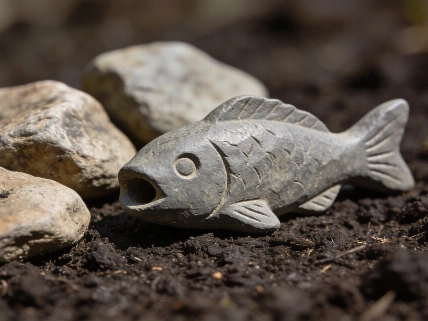
The axe's cutting edge remains sharp, with no visible wear. That condition suggests it was not made for everyday work. Excavation director Stefano Giuntoli considers its preservation, material and archaeological setting consistent with a symbolic object, possibly deposited near the spring. The exact circumstances remain unknown. Italian reporting describes the site as the only currently known evidence in Italy of Neolithic use of naturally hot water, potentially for health-related and cultic purposes.
Stone from the Alps
Pasquino Pallecchi, a diagnostic specialist at the Florence Superintendence laboratory, identified the axe as eclogite through optical microscopy and scanning electron microscopy. During the Neolithic, eclogite and jadeite were among the principal materials used for polished stone axes, which circulated across Europe for nearly three millennia. Some served as tools; others appear to have carried social or symbolic value.
Eclogite was obtained in the western Alps from high-altitude extraction areas as well as river and glacial deposits. The material identification links the axe to Alpine sources, although it does not establish whether the stone or a finished axe travelled to Tuscany. Comparable Alpine stone axes are relatively rare in the region. In a separate example of long-distance circulation, Monviso axes reached deposits and monumental tombs in Morbihan, Brittany, around 800 kilometres from the quarries.
A separate report on Bronze Age antler axes from southern Sweden describes objects made from a different material and belonging to a later period.
The spring cave
The cave formed within a travertine deposit. Earlier investigations located the emergence point of an ancient thermal spring, and radiocarbon analysis places construction of the Neolithic structure between 4495 and 4335 BC. This dates the structure or activity at the site, not the axe itself. The excavation directorate has described the site as a rare setting for studying Neolithic activity around naturally hot water.
Access was through an opening cut into the rock and fitted with several steps. Researchers also identified a constructed stone feature, described in reporting as elliptical, beside the spring. Human-made stone structures were found inside the cave. Their date and purpose were unresolved in the report. The excavation had yielded relatively few pottery and stone artefacts for the size of the area, a pattern researchers considered consistent with a specialized site rather than a permanent settlement.
Pottery includes fragments from vessels made with coarse or semi-refined fabrics, some with relief decoration. Stoneworking remains include flint and jasper cores, along with manufacturing waste. Both groups of finds are consistent with a Neolithic date.
Possible offering
Across Neolithic Europe, polished stone axes have been found in high-status burials and at places interpreted as ritual sites. Some were deliberately deposited in water-associated landscapes, including springs. The unused axe at Sorano, found beside water emerging directly from rock, fits that pattern, but the context does not prove a ritual purpose or establish a formal offering deposit.
Animal remains may help clarify what people did around the spring. Domestic animals dominate the assemblage, particularly cattle. Pigs and sheep are also represented, as are horse-family animals and canids. Wild remains include deer and roe deer; foxes occur in smaller numbers. Several cattle were young or subadult when they died, but the account does not establish whether these remains resulted from ritual activity or routine practices.
The excavation proceeded under a concession from Italy's Ministry of Culture. Specialists are studying archaeological, geological, environmental and animal evidence, using three-dimensional recording and photogrammetry to document the cave and its structures. The radiocarbon date for the structure and the axe's eclogite identification provide distinct lines of evidence: the former places construction in the fifth millennium BC, while analysis by Pallecchi identifies the stone as a material associated with western Alpine sources. As NewTuscia reported, the site is described as a Neolithic setting for the use of hot water for health-related and possibly cultic purposes.
The radiocarbon range of 4495-4335 BC for the structure is reported by InToscana. The axe was identified during the third excavation campaign, and the structures' function and the relationship between the artefacts and animal remains remain topics of archaeological study.