Aerial images reveal overlapping stone rings in Hali on Saudi Arabia's Red Sea coast. Their age and purpose are unknown, and the suggestion that they tracked natural cycles remains unverified
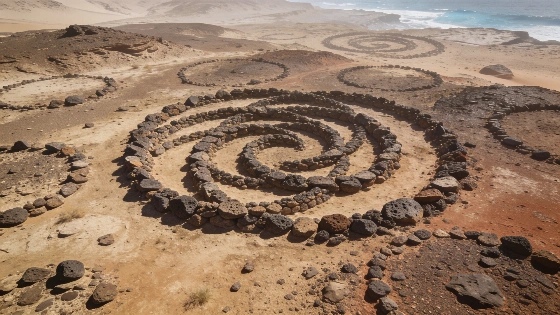
From the air, rings of local volcanic stone form overlapping geometric patterns in Hali, along Saudi Arabia's Red Sea coast. The Saudi Press Agency reported on 13 November 2026 that the formations, in Al-Qunfudhah Governorate, vary in size and configuration and are difficult to make out from the ground. Their arrangement appears deliberate, but the structures have not been dated and their function is unknown.
Historian and researcher Dr Mohammed Al-Marhabi told SPA that the overlapping layout and geometric regularity point to purposeful design rather than random stone placement. He said the visible arrangement does not indicate a residential or burial use. SPA described the formations as an archaeological discovery and called for further specialist research to examine them in their regional context. The Saudi Press Agency report presents possible links to weather observation, seasonal change or celestial movements as questions for further study, not established functions.
An Uncertain Function
Al-Marhabi's interpretation is based on the forms and their spatial arrangement. The aerial imagery shows the rings as interlocking patterns that blend into the terrain at ground level. No construction period or builders have been identified, leaving the formations' chronology and purpose unresolved.
Al-Marhabi suggested they might relate to observing seasonal change. He also raised the possibility of watching weather or celestial movements, but none of these uses has been established.
Hali is in the Tihamah region of Makkah Province, where a fertile valley supported communities along the Red Sea coastal plain and had historical connections with Makkah. Local traditions of seasonal observation and calendar-keeping may offer context, though a connection to the stone circles remains unproven.
Regional Comparisons
Saudi Arabia has other ancient stone structures, but resemblance alone cannot establish a shared date or purpose. In northwestern Saudi Arabia, circular structures investigated by the Royal Commission for AlUla were reported in July 2024 as possible Neolithic houses dating to the sixth and fifth millennia BC. They measure roughly four to eight metres across. Stone slabs formed circular foundations that researchers proposed supported wooden columns and roofing; excavations recovered tools, animal bones and jewellery, as well as evidence of craft production and exchange.
There is no evidence linking those buildings to the Hali circles. A regional archaeology report on Late Neolithic Europe likewise describes shared pottery styles and stone-axe circulation alongside local differences, a reminder that similarities need to be assessed in their own contexts.
At Khaybar Oasis, Al-Natah was a Bronze Age settlement covering around 2.6 hectares and occupied between approximately 2400 and 1500 BC. Its residential and burial areas were connected by narrow paths; some buildings may have had more than one storey, and a large stone wall enclosed the wider oasis.
Those discoveries illustrate the range of ancient stone architecture in Arabia, but they do not clarify the Hali site. The circles' age remains unknown, and their proposed connection to observing the natural world has not been demonstrated.