Paintings in two caves at Tangbaletasi span possible Bronze Age traditions and later Tibetan Buddhist imagery. New imaging reveals hidden motifs while leaving the figures' precise meanings unresolved.
Two caves in China's Altai Mountains preserve evidence of repeated symbolic activity across thousands of years. At Tangbaletasi in the Xinjiang Uygur Autonomous Region, researchers identified imagery that may extend from Bronze Age traditions to later Tibetan Buddhist practice without treating the entire assemblage as the product of one community or one belief system.
The finding matters because the site is not simply a gallery of ancient images. Overlapping pigments, differing styles and inscriptions indicate that later visitors added their own marks beside older figures. The physical record supports continued reuse of the caves, but it cannot by itself recover the beliefs or identities of the people who made each image.
The study, published in npj Heritage Science on October 9, 2026, combined hyperspectral imaging with iconographic comparison, spatial context and historical records. The available publication record describes the research approach, but does not independently provide the full number of spectral channels, pigment identifications, dating accuracy, statistical confidence intervals or sample-size calculations. Those omissions make it important to distinguish the documented method from conclusions that remain interpretive. The study can be consulted through the Springer publication record.
In conservation science, this distinction is central to reproducibility. As in methodological discussions appearing across Nature and research programs associated with MIT and the ESA, an imaging result is strongest when the instrument settings, calibration procedures and uncertainty estimates are reported alongside the interpretation. The available description confirms the use of hyperspectral visualization at Tangbaletasi, but does not supply those complete technical metrics.
Two caves with different records
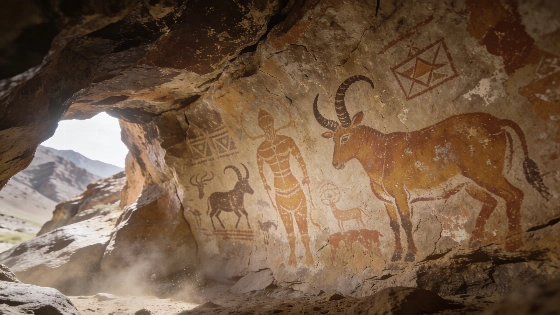
Tangbaletasi lies approximately 70 kilometers from Fuyun County and consists of two natural caves containing anthropomorphic figures, animals, geometric motifs and later inscriptions associated with Tibetan Buddhism. Cave C1 contains 19 identifiable figures, including a three-eyed anthropomorphic face, a bell-shaped figure and several geometric designs. Cave C2 is larger in its visible repertoire, with 51 compositions showing horned anthropomorphic figures, X-shaped symbols and animals.
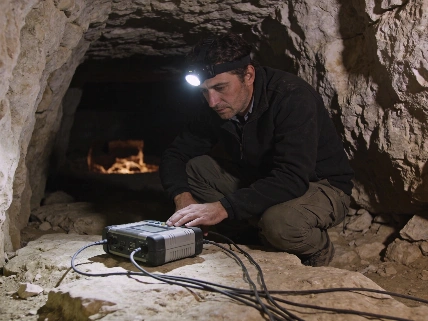
Hyperspectral imaging measures how surfaces reflect light across multiple wavelengths. That information can separate visually similar marks and expose pigment patterns that ordinary photography may miss. At Tangbaletasi, the described analysis revealed two previously invisible motifs and helped researchers compare overlapping pigment areas. However, the available independent description does not list the spectral bands, laboratory affiliations, pigment chemistry or quantitative error margins, so the technique should be understood as evidence for visual differentiation and relative sequencing rather than as an automatic dating instrument.
That sequence is important because the study does not present a single precise date for every painting. Instead, it uses visual comparison, pigment relationships and historical context to separate phases of activity, with some of the earliest imagery attributed to the Bronze Age and later marks linked to Tibetan Buddhism. The publication record confirms the combined methodology, while the more specific chronological attributions should be treated as the authors' interpretations.
Bronze Age comparisons
Comparisons with rock art from Mongolia and the wider Altai region associate some early figures with the Chemurchek culture, which emerged during the third millennium BCE. Other anthropomorphic images share characteristics with art attributed to the Karakol, Okunev and Samus cultures of the Bronze Age. These comparisons are cultural and chronological interpretations rather than direct evidence that members of each named culture visited the caves. No independent government, major archaeological agency or international heritage organization identified in the available search results separately confirms a specific Chemurchek connection.
The three-eyed bearded figure with radiating lines from its head has drawn particular attention because similar representations have been documented across Central Asia and southern Siberia. Such imagery has sometimes been connected with shamanic traditions, but its weathered appearance suggests it may predate the Buddhist imagery and its exact meaning remains uncertain. Neither the publication record nor the available independent material provides a direct statement from the researchers, Chinese heritage authorities or Tibetan Buddhist organizations that would turn this interpretation into an official attribution.
Groups of horned anthropomorphic figures arranged around X-shaped symbols provide another possible ritual context. Their repeated arrangement may represent collective ceremonial activity rather than everyday scenes. That interpretation is plausible from the composition, but the paintings do not establish what ceremony took place or whether the figures depict people, supernatural beings or symbolic forms.
A later Buddhist layer
The later phase is marked by Tibetan script and a crossed vajra symbol. The researchers associate these elements with the Yuan dynasty from CE 1271 to 1368, a period when Tibetan Buddhism expanded across Inner Asia under Mongol imperial patronage. Differences in pigment composition are described as consistent with Buddhist imagery being added during several separate periods rather than in one episode. The available independent search result does not, however, separately verify the Yuan-period dating or provide the underlying compositional measurements.
The surrounding landscape adds context but not a proven explanation. A circular stone burial mound approximately 10 meters in diameter lies around 100 meters from the caves. Its relationship to the paintings has not been established, so it cannot be used as direct evidence that the caves formed part of one funerary complex or that the mound and images were created by the same people.
The repeated layering at Tangbaletasi is best understood as a record of return and alteration. It resembles the interpretive caution required in a related ritual study where material evidence must be separated from claims about belief. At Tangbaletasi, the strongest conclusion is not that one religion occupied the caves continuously, but that successive communities encountered an existing visual environment and added to it.
There is currently no independently reported announcement of new excavations, formal heritage protection, restoration work or an administrative decision concerning Tangbaletasi in the available search results. The documented event is the publication of the research article itself, not a subsequent archaeological discovery or government ruling. Because the available record is dated October 2026, claims about later developments should remain provisional until supported by newer official publications.
Hyperspectral imaging measures differences in how materials reflect light across a range of wavelengths, allowing researchers to distinguish pigments or marks that ordinary photography may miss. It can reveal composition and layering, but it does not translate an image's meaning or provide an automatic calendar date. At Tangbaletasi, the method strengthens the case for multiple phases of activity while comparisons and historical records supply the broader chronology. The evidence therefore supports a long-lived site of symbolic reuse, not a definitive reconstruction of the rituals or identities behind every painting.