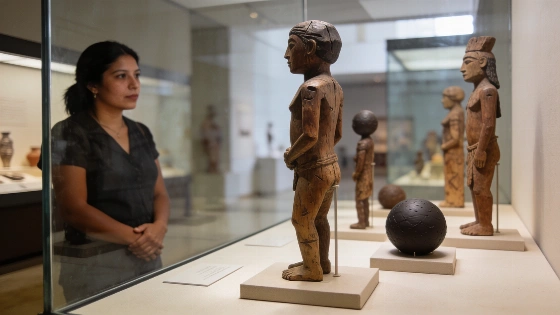
Archaeologists have reunited 3,700-year-old Olmec offerings from Cerro El Manatí, including preserved wooden figures, rubber balls, and jadeite axes, providing new evidence for early Mesoamerican ritual and belief at a sacred Veracruz site
Preserved wooden figures, ancient rubber balls, and jadeite axes-rarely found together in archaeological contexts-are now on display in Mexico for the first time in nearly forty years, offering a direct look at the ritual practices of the Olmec people. The exhibition at the Museum of Anthropology in Xalapa brings together 90 objects excavated from Cerro El Manatí, a waterlogged hill in Veracruz that served as a ceremonial center between roughly 1700 and 900 BCE.
Exceptional Preservation in Waterlogged Context
Cerro El Manatí stands out among Mesoamerican sites for its unique preservation conditions. Archaeologists working in the late 1980s constructed a drainage system to access the waterlogged deposits, which protected organic materials that would otherwise have decayed. The result was the recovery of wooden busts, carved figures, rubber balls, seeds, and even traces of cacao-materials rarely preserved at this age in the region.
Among the most striking finds are 20 anthropomorphic wooden figures, carved from jobo and ceiba wood, some coated with specular hematite or placed alongside mineral fragments. The site also yielded 15 rubber balls, with the oldest examples dating to between 1700 and 1500 BCE and ranging from 10 to 33 centimeters in circumference. These objects provide rare physical evidence for the use of rubber and wood in early Mesoamerican ritual, as well as the long-term significance of the site for repeated ceremonial activity.
Ritual Offerings and Regional Connections
The offerings at Cerro El Manatí were not deposited in a single event but accumulated over centuries, reflecting changing ritual practices. Early deposits included seeds from pumpkin, soursop, hog plum, and other plants, as well as ceramic vessels containing cacao residues. Later phases saw the placement of axes and jadeite beads, some sourced from the Motagua Valley in present-day Guatemala, indicating long-distance connections and exchange networks.
Distinctive arrangements of axes-sometimes in pairs or flower-like patterns-suggest deliberate ceremonial organization. The association of wooden figures with human infant remains, flowers, and mineral pigments points to complex ritual meanings, though the precise symbolic significance remains debated. The repeated return to the site over eight centuries underscores its enduring role in Olmec religious life.
Contextualizing Olmec Ritual Practice
Archaeological evidence from Cerro El Manatí supports the interpretation of the hill, its springs, and surrounding water as central to Olmec cosmology. The site's location within the lower Coatzacoalcos River basin places it in the heartland of early Olmec influence, alongside major centers such as San Lorenzo and La Venta. The exhibition also includes material from related sites, La Merced and El Macayal, broadening the comparative context for understanding regional ritual traditions.
Researchers leading the El Manatí-La Merced project have emphasized that the objects and their deposition reflect ceremonies concerned with fertility, water, and the maintenance of social and ecological balance. Some of these concepts retain resonance among Indigenous communities in the region today. The exhibition uses 3D reconstructions to present the original archaeological contexts, allowing visitors to see how the offerings were arranged and preserved.
While the Olmec are often credited with foundational developments in Mesoamerican art and religion, the evidence from Cerro El Manatí complicates simple narratives of cultural origins. The diversity of materials, the longevity of ritual use, and the preservation of organic offerings challenge assumptions about what can survive and be interpreted from ancient contexts. As with the reported earlier discovery of bear claws in Baltic burials, the survival of rare organic materials can transform our understanding of ritual and social practice.
Material Evidence and Analytical Limits
The exhibition at Xalapa presents 90 objects, including wooden figures, rubber balls, axes, beads, seeds, and ceramics, all recovered from controlled excavations. The dating of the deposits relies on stratigraphic association and radiocarbon analysis of organic materials, establishing a use span from approximately 1700 to 900 BCE. The preservation of untreated wood and rubber is exceptional for the region and period, but the interpretation of ritual meaning remains limited by the absence of written records and the fragmentary nature of the archaeological record.
Some offerings were found with human infant remains, particularly jawbones and long bones, but the context does not allow for definitive conclusions about the nature of these deposits. The association of human remains with ritual offerings is not unique to the Olmec, but the specific practices at Cerro El Manatí remain open to interpretation. The exhibition's curators have avoided speculative claims, instead presenting the material as evidence for repeated, varied, and complex ritual activity over centuries.
The return of these objects to public view after decades in storage is a reminder of the importance of context, preservation, and careful interpretation in archaeological research. The material from Cerro El Manatí does not offer simple answers about Olmec religion or society, but it does provide a rare opportunity to examine the physical traces of ancient ritual in detail. The evidence underscores the need for caution in reconstructing past beliefs from material remains, especially when organic preservation is so rare and the archaeological context is so distinctive.
Organic preservation in archaeology depends on environmental conditions that slow or prevent decay. Waterlogged sites, such as Cerro El Manatí, can create anaerobic environments that inhibit microbial activity, allowing wood, seeds, rubber, and other perishable materials to survive for millennia. However, such preservation is exceptional, and most ancient organic offerings have disappeared from the archaeological record. The survival of these materials at Cerro El Manatí provides a unique window into past ritual practice, but it also highlights the limitations of interpreting ancient belief systems from incomplete evidence. Archaeologists must balance the insights gained from rare finds with the recognition that most organic materials-and the meanings attached to them-are lost to time.