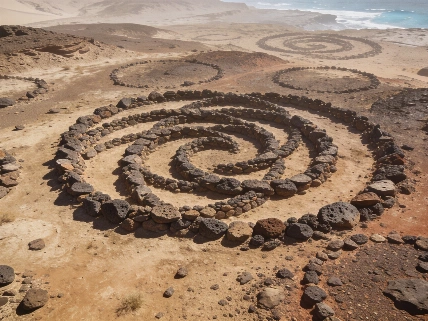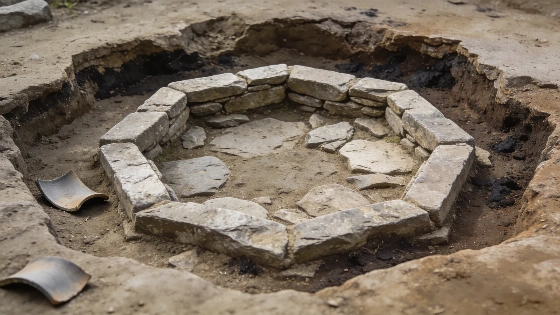
At Ōsato on Kuroshima, archaeologists have mapped an octagonal foundation and traces of burnt earth. Chinese-style roof tiles nearby support a possible religious use, though the building's function remains uncertain
The surviving upper section spans about 8.9 meters between opposite corners, with each side estimated at about 3.4 meters. Traces of burnt earth and surrounding stonework mark the foundations at Ōsato. Archaeologists have also proposed a wider lower section measuring between 10 and 11 meters.
Japanese reporting on 15 November 2026 described the feature as a Heian-period foundation, dating it broadly to the 12th century, around 900 years ago. The report attributed to Satoshi Nakazono, a professor at Kagoshima International University, the view that the remains may have belonged to a religious facility. The exact construction date and the building's height are not established.
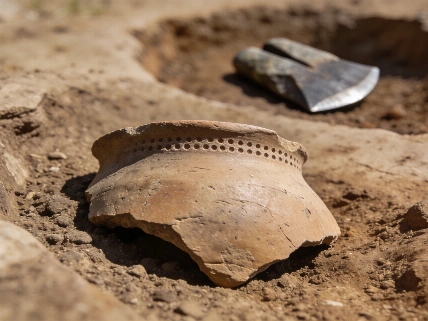
The structure lies on Kuroshima, one of the islands in Mishima Village in Kagoshima Prefecture. Excavations led by Nakazono have investigated the site since 2014, recovering ceramics, roof tiles and other materials from China and several regions of Japan. The assemblage places the foundation within a wider history of maritime exchange, although the finds do not all necessarily belong to the octagonal structure.
A Possible Sacred Building
The upper building has disappeared, so its original form and use cannot be established. Nakazono and his team suggest the octagonal plan may have supported a pagoda, a religious hall or another sacred building. Octagonal architecture is associated with Buddhist structures in Japan and China, but that broader tradition does not confirm the function of the Ōsato remains.
The interpretation draws support from the site's position in an area believed to have religious significance and from Chinese-style roof tiles found nearby. Researchers have compared the foundations with the nine-storey pagoda formerly at Hōshō-ji Temple in Kyoto and the three-storey pagoda at Anraku-ji Temple in Nagano. These structures offer possible parallels, not proof of what stood on Kuroshima.
The unresolved function recalls the uncertainty over the sequence of features in an excavation at Aberlemno III. In both cases, the physical evidence provides a basis for interpretation while leaving parts of the site's history unsettled.
Tiles Across the Sea
The foundations may help explain why roof tiles associated with China's Southern Song period were found at Ōsato. Kuroshima has been described as the southernmost known location in Japan where this type has been identified. Similar tiles have been found at Hakata and elsewhere in Kyushu, areas involved in medieval maritime trade between Japan and China. FNN's report placed the foundation in the 12th-century Heian period and noted the potential relevance of the discovery to research on Japan-Song trade.
In 2015, researchers identified tiles made from the same moulds at Ningbo in China. Later chemical analysis indicated that the tiles found in Japan had also been produced there. The building materials therefore traveled approximately 1,000 kilometers by sea before reaching Japan, although the foundations do not establish whether these particular tiles roofed the octagonal structure.
Nearby Iōjima was known in the medieval period for sulphur, an important commodity exported to China. The ceramics at Ōsato also indicate connections with wider trading networks. Nakazono said the discovery could bring researchers closer to understanding the nature of Japan-Song trade and aspects that had previously been overlooked. Researchers have suggested Kuroshima may have been linked to routes connecting Kyushu and Hakata with China and other places; whether Chinese vessels sailed directly to the island is unknown.
The octagonal foundations give imported building materials at Ōsato an architectural context, while the building's precise function remains undetermined.