
Complex Systems
2 reportsComplex Systems is studied through definitions, proofs, statistical reasoning, computation, models, or structured data. The concept is evaluated through critical transitions, nonlinear dynamics, and primary observations, keeping formal definitions and assumptions separate from observations or consequences.
Evidence from testable consequences is checked against worked examples and nonlinear dynamics. The discussion considers how models are validated and what makes prediction difficult, keeping definitions, predictions, and observations from being conflated.
Evidence from testable consequences is checked against worked examples and nonlinear dynamics. The discussion considers how models are validated and what makes prediction difficult, keeping definitions, predictions, and observations from being conflated.
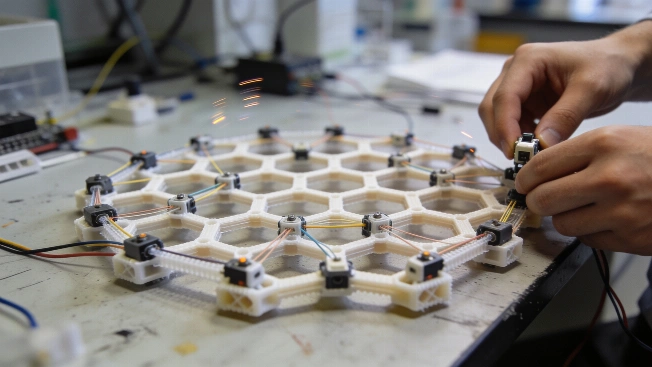
A robotic material finds its own rhythm across 37 units
A laboratory honeycomb of 37 active units turned small vibrations into coordinated movement without an external clock. The experiment shows self-organized motion, but not a robot ready for practical tasks.

Coupled Laser Array Reveals Nonlinear Effects in Percolation Transition
A team has experimentally realized percolation using a 100-laser array, uncovering how nonlinear interactions shift the critical threshold and alter cluster formation compared to idealized models