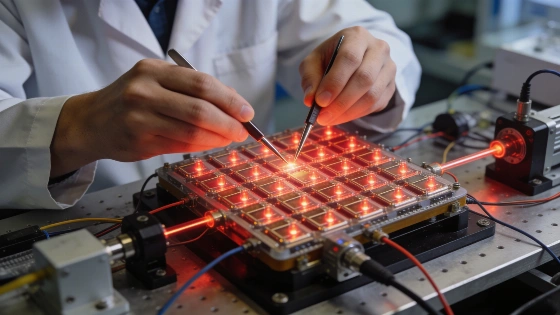
A team has experimentally realized percolation using a 100-laser array, uncovering how nonlinear interactions shift the critical threshold and alter cluster formation compared to idealized models
Percolation theory describes how local connections in a network can give rise to large-scale connectivity, with applications ranging from electrical grids to the spread of disease. While most studies rely on mathematical models or computer simulations, real physical systems introduce additional complexity, including nonlinear interactions, noise, and imperfect coupling. These factors can shift the critical point at which a system transitions from isolated clusters to a single, system-spanning network.
In a recent laboratory experiment, researchers constructed a two-dimensional array of 100 coupled semiconductor lasers to directly investigate percolation phenomena in hardware. Each laser in the array acts as a controllable site, which can be switched on or off and interacts optically with its nearest neighbors. By varying the number and arrangement of active lasers, the team could systematically explore how clusters form and merge as connectivity increases.
Experimental Array and Measurement
The experiment used a square grid of 10 by 10 lasers, with each device optically coupled to its adjacent sites. The system was operated at room temperature, and the pump power supplied to each laser was carefully controlled. Researchers monitored the output of the array to detect both the formation of connected clusters and the onset of phase-locking, where lasers synchronize their emission. This setup allowed the team to observe the emergence of a giant connected cluster and to measure the threshold at which global synchronization occurred.
At high pump power, the array's behavior closely matched predictions from ideal percolation models: as more lasers were activated, clusters grew and eventually merged into a single spanning cluster, accompanied by a smooth, second-order phase transition. The critical threshold-the point at which this transition occurred-was consistent with theoretical expectations for a two-dimensional lattice.
Nonlinear Effects and Threshold Shift
However, when the pump power was reduced, the system deviated from idealized behavior. Nonlinear competition between lasers became significant, suppressing the formation of weakly connected clusters and requiring a higher fraction of active sites to achieve global connectivity. This shift in the percolation threshold was contrary to the common assumption that nonlinear effects dominate only at high power. The researchers found that at lower pump levels, the lasers' mutual influence altered the rules of connectivity, effectively making it harder for clusters to persist unless they were strongly supported by their neighbors.
To account for these observations, the team developed a modified percolation model in which a site remains active only if it has a sufficient number of active neighbors. This adjustment reproduced the experimental results, demonstrating that nonlinearities can fundamentally reshape the percolation transition in real systems. The findings highlight the importance of considering physical constraints and interactions when applying percolation theory to engineered or natural networks.
Implications for Complex Networks
The demonstration provides a rare example of percolation studied in a fully controllable physical platform, bridging the gap between abstract models and real-world systems. The coupled laser array enables direct measurement of both connectivity and synchronization, revealing how local nonlinearities can shift global behavior. While the experiment does not establish a new quantum technology or practical device, it offers valuable insight into the interplay between network structure, competition, and collective dynamics in photonic and other complex systems.
The research, published in a peer-reviewed journal, underscores that idealized models may not capture the full range of behaviors in physical networks, especially when nonlinear effects are present. Future work could extend these methods to larger arrays, different coupling geometries, or systems operating in the quantum regime, where additional effects such as quantum noise and entanglement may further modify percolation transitions.
Percolation is a statistical process describing how local connections in a network lead to the formation of large-scale clusters. In a typical percolation model, sites or links are randomly activated, and the system undergoes a phase transition when a critical fraction is reached, resulting in a giant connected component. In physical systems, however, factors such as nonlinear interactions, noise, and imperfect coupling can shift this threshold and alter the nature of the transition. Understanding these effects is essential for accurately modeling connectivity in real-world networks, from photonic devices to biological and technological systems.