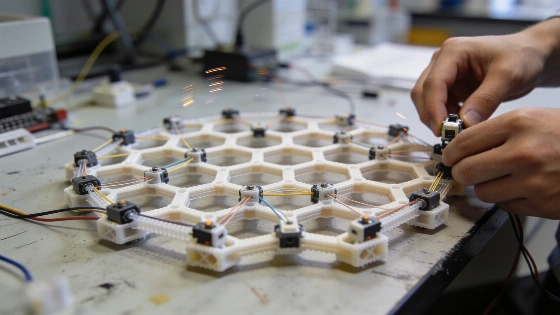
A laboratory honeycomb of 37 active units turned small vibrations into coordinated movement without an external clock. The experiment demonstrates self-organized motion but not a robot ready for practical tasks
Thirty-seven linked units began with small vibrations and settled into a shared rhythm without receiving a timing signal. Reported on October 14, 2026, the work demonstrates a laboratory robotic material organizing its own motion-not a machine independently carrying out useful tasks.
The international team included researchers from the universities of Amsterdam, Leiden, Birmingham, Lyon, Delft and Cambridge. Their study, Wave coarsening drives time-crystallization in mechatronic metamaterials, was published in Nature. The researchers built two experimental structures: a two-dimensional honeycomb with 37 active units and an elastic ring with 24 motorized units. Both developed repeating movement patterns through interactions among their components.
The researchers describe the behavior as time crystallization: a pattern that repeats over time, rather than the repeating spatial arrangement of an ordinary crystal. The concept brings together active matter-systems that use their own energy to sustain motion-and the study of recurring dynamic states. The team's biology-inspired approach aims for coordination to emerge from interactions between building blocks rather than instructions from a central controller, as described in the University of Birmingham announcement.
The honeycomb units initially oscillated at about 30 hertz, or 30 cycles per second. As the system moved beyond its stability threshold, short-wavelength oscillations gave way to patterns with longer wavelengths, periods and amplitudes. The researchers call this progression "wave coarsening." The structure then moved collectively, without an external clock. In the ring, higher-frequency deformations likewise combined into larger-scale patterns until the structure reached a slower repeating cycle.
The material combines elastic structures with sensors, electronics and actuators that convert electrical energy into physical movement. Each unit can affect its neighbors through designed nonreciprocal interactions: one component's influence on another does not have to produce an equal response in return. The experimental structures included more than 100 sensors and actuators, 3D-printed components and custom Lorentz actuators. Corentin Coulais, who leads the Amsterdam research group, and the wider team identify these asymmetric interactions as a key ingredient in the formation of the collective rhythm.
Experiments and mathematical modeling showed that random disturbances did not destroy the organized oscillations. The researchers also examined how the pattern behaved as the modeled system grew in size. These results concern the stability of collective motion, not the reliability of an autonomous machine operating in a changing environment.
The experiments demonstrate coordinated oscillations, not walking, manipulating objects or switching between useful robotic tasks. The team has not demonstrated controlled switching among movement modes. Three-dimensional active materials able to bend, shear and twist are a future direction for the work. The researchers also identify controlling shape changes and directed motion as possible applications of wave coarsening in robotics, active matter and optomechanics.
The approach belongs to a wider effort to build motion into materials rather than assemble every movement from separate mechanisms. Related work on fiber-based robotic actuators explores how actuator design can produce movement in flexible structures, while the present study focuses on collective coordination across connected units.
Here, "time crystallization" refers to recurring motion, not a material that moves forever without energy or outside influence. An oscillator repeats its motion; coupled oscillators can synchronize when their interactions favor coordinated rhythms. In this experiment, the researchers engineered those interactions and observed the resulting patterns. The term describes the temporal order they measured, not evidence that the material has agency or can perform tasks on its own.