
Quantum Vacuum
3 reportsQuantum Vacuum is a physics concept expressed through equations, measurable quantities, limiting conditions, and testable predictions. Its scientific meaning is clarified through symmetry relation, experimental test, and governing equation, with attention to testable predictions and limiting cases.
The subject is made concrete through links to other theories, unresolved questions, and mathematical formulation in reporting on Quantum Vacuum. To distinguish observation from inference, reporting sets independent experiments beside quantitative predictions in the discussion of unresolved questions; the strongest interpretation still recognizes that agreement within one regime does not guarantee validity beyond tested conditions.
The subject is made concrete through links to other theories, unresolved questions, and mathematical formulation in reporting on Quantum Vacuum. To distinguish observation from inference, reporting sets independent experiments beside quantitative predictions in the discussion of unresolved questions; the strongest interpretation still recognizes that agreement within one regime does not guarantee validity beyond tested conditions.

NASA's IXPE Observes Magnetar and Tests Quantum Vacuum Theory
NASA's IXPE telescope spent over 140 hours observing magnetar 1E 1547-5408, collecting X-ray polarization data that may reveal how empty space behaves in extreme magnetic fields
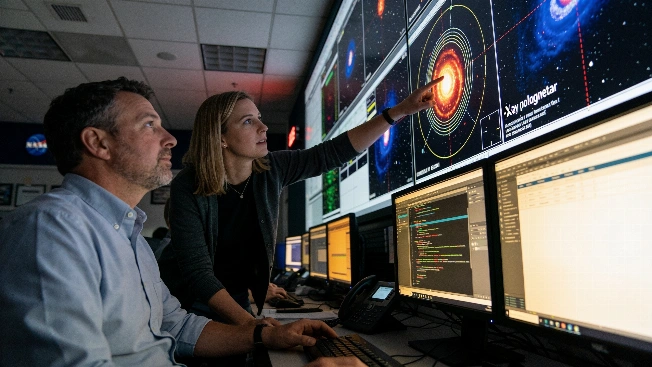
NASA's IXPE Detects Signs of Quantum Vacuum Effect Near Magnetar
NASA's IXPE telescope has measured X-ray polarization from a magnetar, providing evidence consistent with a quantum electrodynamics effect predicted for nearly a century but never directly observed in space
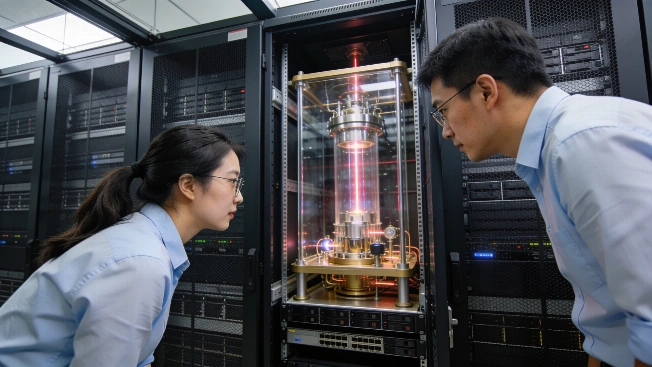
Neutral-Atom Quantum Computer Fits Standard Server Rack in Shanghai Debut
A Chinese startup has introduced Qinghe No. 1, a neutral-atom quantum computer designed for direct installation in data-center server racks, aiming to bypass the need for large cryogenic systems and accelerate enterprise quantum hardware integration