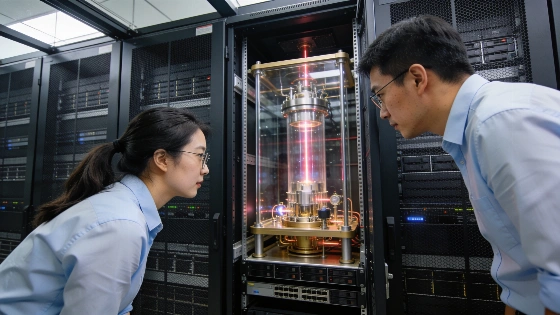
A Chinese startup has introduced Qinghe No. 1, a neutral-atom quantum computer designed for direct installation in data-center server racks, aiming to bypass the need for large cryogenic systems and accelerate enterprise quantum hardware integration
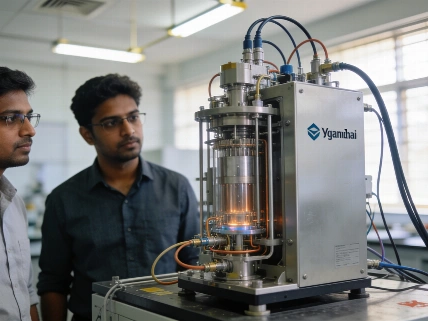
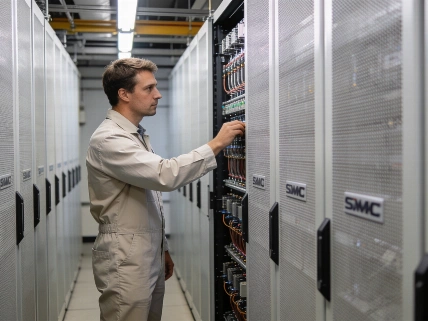
At the World Artificial Intelligence Conference (WAIC 2026) in Shanghai, Zhongqi Wuliang presented Qinghe No. 1, a neutral-atom quantum computer engineered to operate within a standard data-center server rack. Unlike superconducting quantum processors, which require dilution refrigerators to reach millikelvin temperatures, neutral-atom systems use laser-cooled atoms trapped in vacuum chambers, allowing for operation at higher temperatures and more compact form factors. Zhongqi Wuliang, a spinout from the Chinese Academy of Sciences' Shanghai Institute of Optics and Fine Mechanics, positions this device as a step toward integrating quantum hardware into conventional enterprise IT environments.
Neutral-atom quantum processors rely on arrays of individual atoms held in place by optical tweezers-highly focused laser beams that confine atoms in a vacuum. The atoms are cooled to microkelvin temperatures using laser pulses, eliminating the need for external cryogenic plumbing. Two-qubit gates are implemented by exciting atoms to Rydberg states, where strong dipole-dipole interactions enable conditional logic operations. The entire system, including the vacuum chamber, laser delivery, and control optics, is packaged into a single server-rack chassis. This approach is intended to reduce the infrastructure and energy demands that have limited the deployment of quantum computers in enterprise settings.
According to the company, the integration of metasurface chips-developed by supply chain partner Xuanxiang Technology-enables the generation of large-scale optical tweezer arrays, simplifying optical alignment and potentially supporting larger qubit arrays. However, Zhongqi Wuliang has not yet released peer-reviewed technical data for Qinghe No. 1, such as the number of operational qubits, two-qubit gate fidelities, or coherence times. Without independent benchmarks, it is not possible to compare the system's performance to established neutral-atom platforms, such as those developed by QuEra or other international groups.
China's Neutral-Atom Hardware Cluster
Qinghe No. 1 is the third neutral-atom quantum system to be commercially announced in China within a year. In October 2025, Zhongke Kuyuan delivered Hanyuan-1, a 100-qubit room-temperature neutral-atom device occupying three equipment racks, to a China Mobile subsidiary and exported a unit to Pakistan. In May 2026, Hanyuan-2 was introduced as a dual-core cabinet system with power consumption below 7 kW, designed for parallel processing or logical qubit encoding. Qinghe No. 1, launched in July 2026, is the first Chinese neutral-atom system to claim a single-rack form factor, reflecting a trend toward smaller physical footprints and data-center compatibility.
This rapid hardware development is supported by municipal industrial policy in Shanghai, where neutral-atom quantum technology has been designated a strategic focus. Dedicated innovation zones, including the Xuhui Cultivation Zone and Zhangjiang Quantum Bay, have been established with state research funding and municipal subsidies to accelerate commercialization and supply chain integration.
Technical and Market Context
While the server-rack design addresses a key engineering barrier for enterprise quantum adoption, the absence of published technical specifications limits independent assessment. Critical performance metrics-including physical qubit count, gate fidelity, and coherence time-remain undisclosed. As a result, technical buyers and researchers cannot yet evaluate whether Qinghe No. 1 matches or exceeds the capabilities of international neutral-atom systems, or whether it is suitable for practical quantum algorithms beyond proof-of-concept demonstrations.
The announcement comes amid growing global interest in neutral-atom architectures. In early 2026, Google Quantum AI launched a dedicated neutral-atom research program in Boulder, Colorado, citing the potential for reconfigurable connectivity and scalability. However, the field remains highly competitive, with performance and reproducibility varying widely across platforms and no consensus on the optimal path to fault-tolerant quantum computing.
According to reporting from TechTimes Hardware Coverage and Pandaily, the debut of Qinghe No. 1 signals China's intent to compete in the neutral-atom quantum hardware sector, but the lack of peer-reviewed benchmarks means that claims of enterprise readiness should be treated with caution until independent verification is available.
Neutral-atom quantum computers use individual atoms-typically alkali metals such as rubidium or cesium-trapped and manipulated by laser fields in a vacuum. Each atom serves as a physical qubit, with quantum information encoded in internal energy states. The use of Rydberg excitation enables strong, controllable interactions for multi-qubit gates. Unlike superconducting or trapped-ion systems, neutral-atom platforms can, in principle, support flexible qubit layouts and dynamic reconfiguration. However, practical performance depends on precise laser control, vacuum stability, and mitigation of noise sources such as stray fields and laser fluctuations. The transition from laboratory demonstration to reliable, scalable quantum computing remains a central challenge for all hardware platforms, including neutral-atom systems.