
Paleobotany
1 reportPaleobotany is the study of fossil plants and plant-like organisms, combining botany, paleontology, geology, and evolutionary biology. Researchers identify leaves, wood, seeds, spores, pollen, and microscopic tissues to reconstruct ancient vegetation, trace the origin of major plant groups, and infer past temperature, rainfall, fire, and atmospheric conditions.
Coverage places ancient vegetation and climate; stratigraphic occurrence; and plant taphonomy within the wider context of Paleobotany. Complementary views of plant taphonomy come from sedimentological observations and independent age constraints, but the conclusion remains bounded because the comparison must account for the fact that the fossil record is incomplete and preservation can favor particular organisms or environments.
Coverage places ancient vegetation and climate; stratigraphic occurrence; and plant taphonomy within the wider context of Paleobotany. Complementary views of plant taphonomy come from sedimentological observations and independent age constraints, but the conclusion remains bounded because the comparison must account for the fact that the fossil record is incomplete and preservation can favor particular organisms or environments.
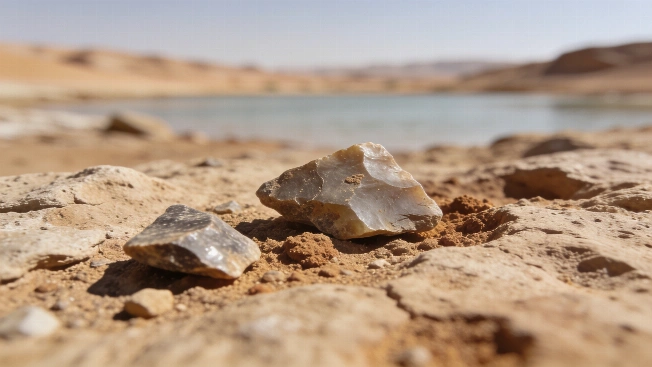
A 125,000-Year-Old Lake Reveals Human Life in Arabia
At Uruq al-Julaybah, a reconstructed 340-square-kilometer lake and thousands of stone artifacts place human activity in wetter Arabia about 125,000 years ago; residues offer clues to tool use and plant processing