
Albert Einstein
5 reportsCoverage distinguishes how Brownian motion and mass-energy equivalence, with separate attention to special relativity shape the interpretation of Albert Einstein. The analysis checks questions about special relativity against subsequent independent work and original papers; the main constraint is that retrospective fame can simplify collaboration, priority, and the limits of the original claims.

High Energy Photon From Distant Gamma Ray Burst Challenges Physics Limits
A photon with record-breaking energy from the gamma ray burst GRB 221009A reached Earth despite theoretical barriers. New analysis suggests a possible explanation involving axion-like particles and Lorentz invariance violation

Quantum test reveals Einstein's gravity holds for falling atoms
A new experiment using ultra-cold rubidium atoms has measured how gravity affects quantum waves, providing the first direct test of Einstein's equivalence principle in the quantum regime
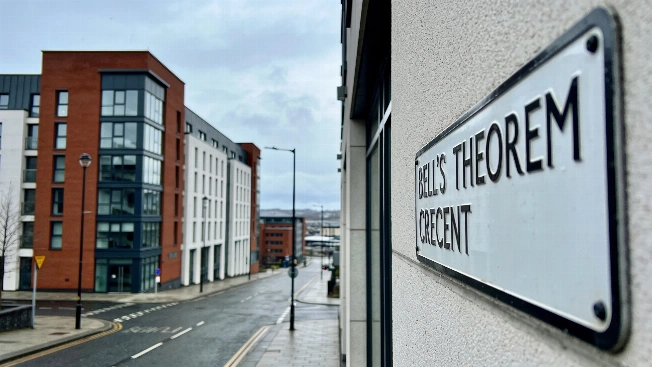
How Bell's Theorem Emerged from an Unusual Physics Journal
John Bell's 1964 theorem on quantum nonlocality was first published in a short-lived journal with an unconventional editorial model. The story of this publication highlights the challenges of peer review, editorial selection, and scientific recognition in quantum physics
Webb Telescope Uses Gravitational Lensing to Reveal Ancient Galaxies
The James Webb Space Telescope has captured a detailed image of the galaxy cluster MACS J0553.4-3342, using gravitational lensing to magnify galaxies from the universe's first billion years
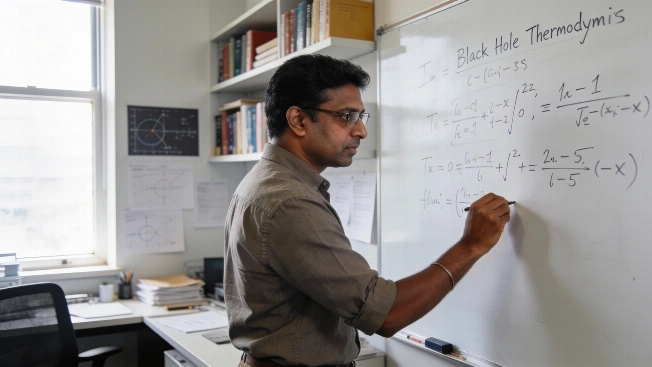
Black Hole Thermodynamics Updated Beyond Hawking's Original Theory
Physicists have proposed a new framework for describing black hole energy loss, extending thermodynamic laws to dynamic black holes and addressing a key limitation in Stephen Hawking's classic model