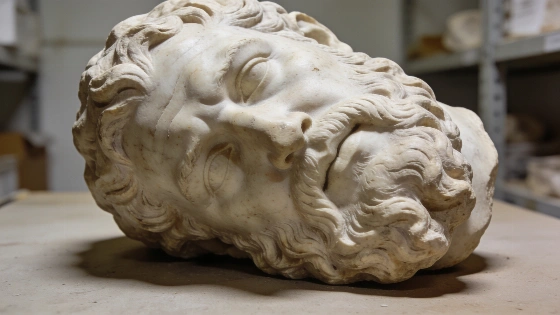
The marble head was recovered in İzmir's Konak district during an operation involving provincial police branches. Authorities classify it as protected cultural property but have not identified its original findspot or archaeological context
On 21 October 2026, officers from the anti-smuggling unit and intelligence branch of the İzmir Provincial Police Department took part in an operation coordinated by the İzmir Chief Public Prosecutor's Office. The operation targeted the smuggling of historical artefacts in Konak, İzmir, western Türkiye. The Demirören News Agency report by Kadir Özen said a marble head depicting Zeus was recovered during the operation.
Authorities classified the object as cultural property requiring protection under Türkiye's Law No. 2863 on the Protection of Cultural and Natural Assets. Three suspects were detained in connection with the case on suspicion of violating the law. Turkish media describe the sculpture as Roman-period and approximately 2,000 years old; the age is a reported estimate, rather than a published scientific dating result.
The missing context
Authorities have not disclosed where the head was originally discovered. No excavation context has been reported linking it to a particular site, building or deposit, and its earlier route into circulation has not been made public. Its archaeological provenance therefore remains unknown.
A Roman-period attribution does not identify the place where a sculpture was made, the community that commissioned it or the setting in which it was displayed. The public account gives no details of the dating method or the examination used to identify the figure as Zeus.
The distinction between a reported findspot and a secure archaeological context also matters in a musket-fragment report about objects found along a possible retreat route. In both cases, a proposed connection to a place or event requires evidence beyond the object's presence at a location. For the Zeus head, no site association has been announced.
DHA reported that the sculpture was recovered during the operation and that three suspects were detained. The object was placed under protection, while its destination before the seizure has not been disclosed. The public account gives no further details about its precise date, origin or intended destination.
Zeus in Anatolia
Zeus held the highest position among the gods of ancient Greece and was associated with the sky and thunder. Greek artists commonly represented him as a mature, bearded male figure, sometimes with a thunderbolt or sceptre; an eagle could also appear as his symbol. The report identifies the recovered head as Zeus but does not describe features that would allow readers to assess that identification independently.
In Greek mythology, Zeus was the son of Cronus and Rhea and a sibling of Poseidon, Hades, Hera, Demeter and Hestia. After Zeus and his brothers defeated Cronus and the Titans, the brothers divided the universe among themselves, with Zeus ruling from Mount Olympus. These stories formed part of the religious and artistic traditions that travelled across the Greek world.
After Rome conquered the Greek world, Greek religion and mythology became part of Roman religious life. Zeus was closely associated with Jupiter, the chief deity of Roman state religion, while Greek artistic conventions continued to shape depictions of the god during the Roman period. In Anatolia, the cult of Zeus was worshipped under regional titles and forms across the Greek, Hellenistic and Roman periods.
Western Anatolia included important ancient cities such as Ephesus, Pergamon, Smyrna and Sardis, where Greek and Roman religious traditions formed part of civic and cultural life. That regional history supplies context for a Zeus image, but it cannot place this head in any one city. No association with those centres has been reported.
Archaeological provenance means more than a general regional origin: it records where an object was found and the circumstances in which it was recovered. A documented layer or architectural setting can connect an artefact with other material and help researchers assess its use and date. Without that record, the head may still be identified as an ancient sculpture, but its specific archaeological relationships cannot be reconstructed from the information released so far.