A trench opened in Caraca's tenth excavation campaign exposed a structure first detected by ground-penetrating radar. Its position beside the forum adds a confirmed religious building to the Roman city's mapped center
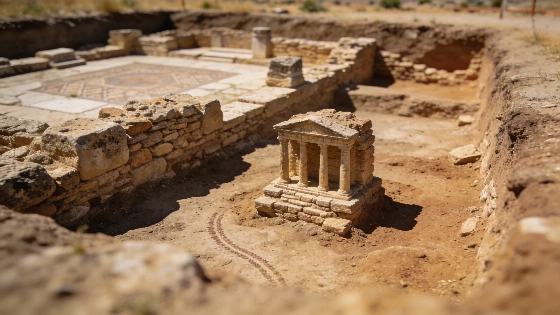
At Caraca, a trench opened during the 2026 campaign exposed a building on the western side of the forum. Ground-penetrating radar had previously detected the structure, but only excavation confirmed its religious function. Caraca lies on the Cerro de la Virgen de la Muela near Driebes, in Guadalajara province, core Spain. Systematic archaeological investigation began in 2016, making the 2026 work the site's tenth excavation campaign.
The temple is one of several features researchers are using to reconstruct the city's monumental center. Excavation co-director Emilio Gamo described it as small but interesting. The campaign was the first since Driebes City Council acquired all the land covering the archaeological site, as ENCLM reported.
Mapping the forum
The temple stands on the western side of Caraca's forum, while archaeologists have also examined a cryptoporticus on the eastern side. A cryptoporticus is a covered or partly subterranean gallery; at Caraca, researchers are investigating its role within the public complex. The forum, gallery, temple and principal streets are being studied together to map the settlement's civic and monumental layout.
Local reporting describes the temple as an in antis building, approximately 25 square metres in area and about 4.5 by 5.5 metres. Its interior had a porch, or pronaos, and a principal chamber, or cella, of nearly 16 square metres, divided by a wall with a fitting for a door. The walls were built from local gypsum blocks and coated with mortar.
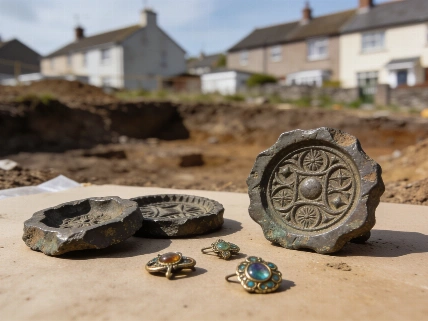
Fragments of a collapsed roof made from flat and curved Roman tiles were recovered. Two ceramic female-figure ornaments, identified as antefixes, were found among the roof debris and were described as decorations that probably adorned the roof edge. Archaeologists also identified a large entrance gate immediately south of the temple. Paco Campos detailed the building and finds in Nueva Alcarria.
The temple's architecture and recovered materials are being considered in relation to the history of Caraca's civic status. The excavation report cautioned that a temple alone cannot establish what rank the city held, whether it obtained a particular legal status or when any change took place.
Elsewhere in the city, work has traced the decumanus, a principal street that generally ran east to west in Roman settlements. Researchers are using its route to understand how public buildings and residential areas were laid out.
Layers beneath the city
A deep stratigraphic sounding reached more than two metres below the surface. It exposed deposits extending from the Roman period to the end of the Bronze Age, recording human activity at the site before the Roman city. Gamo said older levels may survive below those already reached. A separate account of Late Bronze Age defenses at Palaepaphos describes evidence from another site, where construction phases help establish the history of its fortifications.
Buildings and daily life
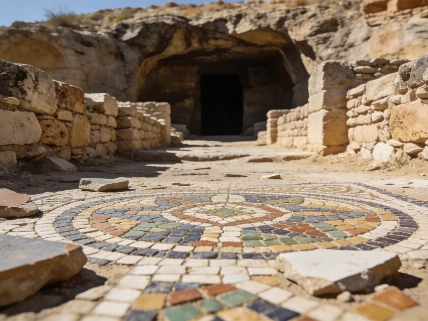
Excavation also revealed a room in the bath complex dating to the first or second century AD. Its floor used opus reticulatum, a Roman masonry technique made with small diamond-shaped pieces arranged in a regular pattern. Researchers completed excavation of one bath pool and carried out consolidation and restoration work on the complex's architectural remains.
The 2026 campaign comprised 55 test trenches across the site. Five were opened in different areas of the city, with another in the bath complex. The work combined excavation with geophysical survey, using buried anomalies to guide targeted digging. At the temple, the process led from a radar detection to an excavated and identified religious building.
Caraca's street plan and structures have survived with relatively little later development over the site. Systematic investigation began in 2016, giving archaeologists the chance to study the settlement using modern excavation and recording methods.
The 2026 season was the first since Driebes City Council acquired all land covering the archaeological site. It was the tenth excavation campaign at Caraca.