A GPS-recorded findspot lies along the route taken by Polish troops after the 1792 battle, but the corroded sections have no confirmed date or direct link to the retreat
The recorded findspot lies in the direction Polish forces took as they withdrew after the Battle of Dubienka in 1792. The battle took place during the Russo-Polish War of 1792. That makes the location significant, but it does not establish when the damaged firearm barrel was left there or who carried it.
What survived
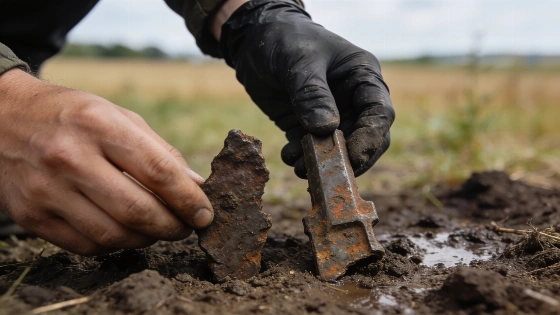
Searchers working under an archaeological permit recovered two heavily corroded sections near one another. The work was carried out by members of the Lubelszczyzna Historical Foundation from Gorzków, who had previously taken part in investigations of the battlefield. Regular excavations near Uchańka, in the Dubienka commune, have been temporarily suspended, while searches conducted with archaeologists continue.
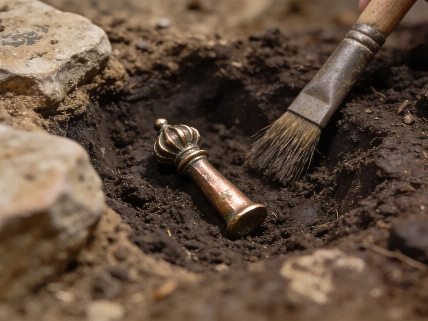
The sections measure about 41 centimeters and 21 centimeters long. They do not join, so part of the barrel is missing. One preserves the breech, including the powder chamber and firing vent; the other comes from the muzzle end. The barrel appears to have been bent and broken, and no other firearm components were found beside it.
Its surviving form is consistent with a smooth-bore, muzzle-loading flintlock firearm. The profile is mostly circular, becoming apparently octagonal near the breech. Its diameter is about 21 millimeters at the muzzle and 25 millimeters toward the rear. Metal fittings may have helped secure or guide the ramrod, which was used to load the firearm.
A possible battlefield link
The construction suggests an infantry musket or a similar firearm from the late 18th or early 19th century. Polish and Russian forces used weapons of this general kind during the period, but that broad resemblance cannot identify the barrel's user. Conservation and comparative study are still needed before researchers can establish its precise type or possible place of manufacture.
The findspot was recorded with GPS and falls along the route of the Polish retreat. Other military objects, including ammunition and soldiers' equipment, have been recovered around Uchańka. Historical accounts also describe Polish troops encountering pursuing Russian forces after leaving the main battlefield. Taken together, this makes the retreat a reasonable focus for investigation, not a proven explanation for this particular object.
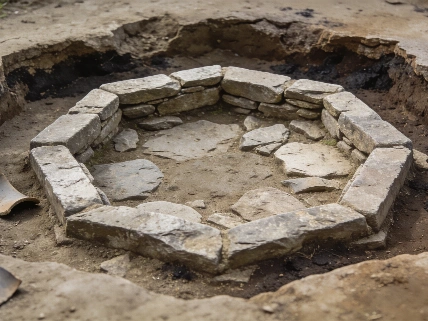
Archaeological interpretation depends on that distinction. A separate Kakavaria excavation report describes a structure whose function and chronology remain unresolved, illustrating how physical evidence can constrain an interpretation without settling it. Here, the location and nearby military finds provide context, while the barrel itself has not been directly tied to a documented episode in 1792.
Dating remains open
Researchers say the proposed identification is preliminary. A hunting firearm remains a possible alternative, as does a weapon from later in the 19th century. The apparent bending and breakage could fit a battlefield connection, but damage alone cannot establish when or why it happened.
Large firearm sections are uncommon among battlefield finds of this period, because damaged or abandoned weapons were often collected for reuse, repair, or their metal. Researchers involved in the investigation say this appears to be the first fragment of a small firearm of this size recovered from the Dubienka battlefield or its immediate surroundings. That claim describes the known finds, not the frequency of firearms across the entire historical battlefield.
The two pieces still require conservation and detailed examination. Because they do not connect, another portion may remain nearby, but its presence has not been confirmed.
In archaeology, context means the documented relationship between an object and the place where it was recovered. A recorded position can help researchers compare a find with nearby material and historical routes. It cannot, on its own, prove that an object belonged to a particular person or event. In this case, the GPS location preserves where the fragments were found near Uchańka.