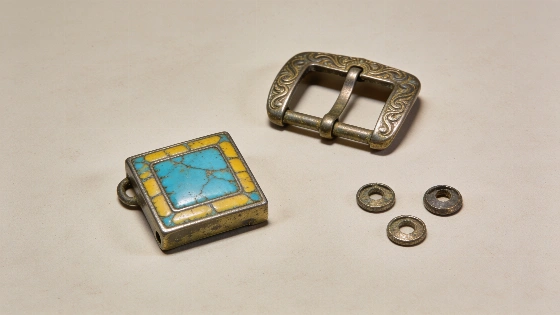
A 2.1-centimeter enamel buckle and nearby belt fittings found in Chechen Forest have been dated by their form to the 2nd-3rd centuries AD. Their owner and the circumstances of deposition remain unknown
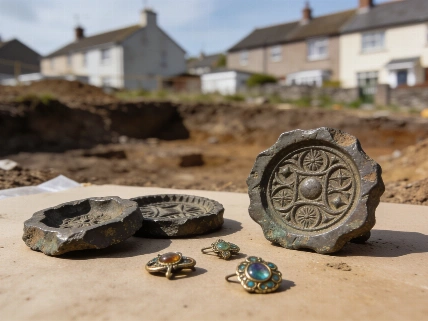
A square buckle measuring about 21 by 22 millimetres-roughly 2.1 centimetres across-carries turquoise, blue and yellow enamel. Local residents found it in Cecyna (Tsetyn) Forest near Chernivtsi, Ukraine, during fieldwork connected with RESTORY, a history-and-folk-culture project funded through the European Union's Horizon Europe programme. They handed the objects to Antonii Moisei, a professor and head of the Department of Social Sciences and Ukrainian Studies at Bukovinian State Medical University, for examination.
The buckle was found with an ornate belt fitting and three small circular metal plates, making five pieces in all. The buckle and fitting feature coloured champlevé enamel, in which colour is set into recessed cells in the metal. Moisei dated the pieces to the second or third century AD based on their form, construction and decoration. Comparisons of their enamel, patterns and construction point to Roman provincial craft traditions, particularly those of Roman Dacia, as described in Archaeology Magazine's report. The three circular pieces are thought to belong to the same belt, though their original arrangement is uncertain.
A Possible Sarmatian Link
Moisei has proposed that the fittings may have belonged to a Sarmatian horseman, perhaps a cavalryman. Sarmatian groups, associated with nomadic and semi-nomadic societies across the Eurasian Steppe, lived around the northern and northwestern Black Sea during this period. Their proximity to Roman territories enabled contact, trade and the movement of Roman-made or Roman-influenced objects across imperial frontiers.
The resemblance to Roman provincial workmanship, including Dacian craft traditions, does not establish who owned the fittings. Trade or exchange are possible routes for the objects to have reached the region; military acquisition or capture as spoils are other possibilities. The Sarmatian association remains a hypothesis, and the owner is unknown.
Earlier evidence of objects moving across the wider region includes Black Sea ornaments found at Kostenki 14, more than 41,000 years ago. That much earlier find is separate from the belt and does not establish a direct connection between the objects.
Context Remains Unknown
Ornamented belts could signal a wearer's status, identity or cultural connections, as well as serving a practical purpose. Here, the dating is based on typological comparisons of the fittings' form, construction and decoration, rather than a direct scientific dating method.
Residents recovered the objects during project fieldwork, not in a controlled archaeological excavation. No burial or settlement context is associated with the find, and it remains unknown whether the belt was deliberately placed there, accidentally lost or part of a wider archaeological context. The five fittings therefore cannot establish the wearer's identity or the circumstances of deposition; the proposed connection to a Sarmatian cavalryman rests on their form, date and cultural parallels.