Radiocarbon results from 16 people place use of two collective tombs near Cádiz between about 1875 and 1625 BC. The dates raise a separate question: were the monuments built then too?
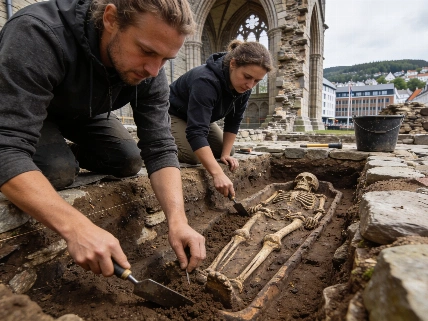
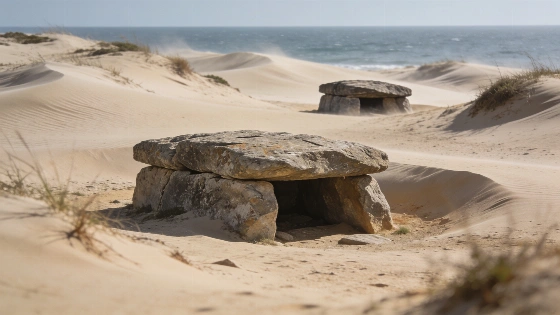
The Trafalgar necropolis lies beneath the dunes of Cape Trafalgar, near Barbate in Cádiz, on Spain's southern Atlantic coast close to the Strait of Gibraltar. Two monumental tombs there held the remains of 20 people, including children and adults. The study, led by Eduardo Vijande-Vila of the University of Cádiz, was published in PLOS ONE on November 11, 2026, under the title "The last builders of megaliths in the South of the Iberian Peninsula?"
Researchers obtained 16 radiocarbon dates from human remains recovered from the tombs. Bayesian chronological modeling places their funerary use between approximately 1875 and 1625 BC-about 3,900 to 3,600 years ago-making Trafalgar one of the latest known examples of collective megalithic burial in Iberia. The published study models the dates from Tomb I and Tomb II separately and also presents a shared, contiguous phase of activity. The 16 dated individuals are part of the 20 people identified in the tombs.
Late use or new construction
Across much of Iberia, Bronze Age funerary customs shifted away from the large communal tombs common in earlier periods. Individual graves and burials for smaller groups became more common. Trafalgar shows that this change did not happen uniformly across the peninsula: collective burial continued there during the early second millennium BC, even as funerary practices elsewhere were becoming more individualized.
The radiocarbon dates establish when sampled human remains belonged to living people and when the tombs were used for burial. They do not establish when the stone structures were built: older megalithic monuments could be reopened and reused centuries after their construction. The study's model supports a shared broad period of funerary activity in both tombs, but does not show that the structures were built at the same time.
Archaeologists have found no earlier occupation or burials associated with the tombs, and no earlier archaeological material around the necropolis. The researchers therefore suggest that the site may have been established shortly before the dated burials, during the early second millennium BC. This interpretation raises the possibility that the monuments were built during the Bronze Age, but the radiocarbon dates are from human remains rather than the stone architecture. A separate report on Somló Hill settlement documented Bronze Age metal deposits and craft evidence in Hungary, a different archaeological record from Trafalgar's collective burials.
A coastal burial landscape
The researchers describe Trafalgar as a funerary space in a landscape strongly shaped by the sea and close to the Strait of Gibraltar. The remains of children and adults show that the collective tombs were not restricted to adults alone. The University of Cádiz highlights the contrast between continued shared burial at Trafalgar and the growing use of individual burials and greater social differentiation in other communities.
The absence of earlier archaeological material supports the researchers' proposal that the burial landscape may have been established during the Bronze Age rather than inherited from a much earlier community. It does not confirm the monuments' construction date. Further dating of materials connected with the architecture would be needed to establish when the tombs themselves were built.
Buried by shifting sand
Strong winds and moving sands repeatedly alter the coastal landscape around Trafalgar. Archaeological remains exposed by erosion may later be covered again, making it difficult to determine how far the necropolis extends.
Conservation work and further excavation are needed to establish the site's extent. Until the monuments themselves are dated, their construction during the Bronze Age remains a possibility rather than a confirmed finding.