At Tunnug-1, six radiocarbon-dated seeds and cannabinoid traces in preserved hair place plant remains and human exposure in one early eighth-century BCE burial complex; the evidence cannot reveal how the compounds entered the body
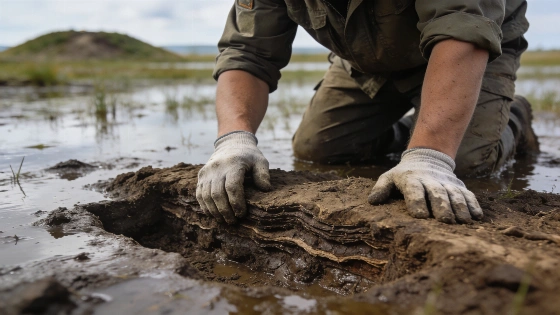
Waterlogged ground at Tunnug-1 preserved organic material that would usually decay, giving researchers access to botanical remains and chemical traces in human hair. The monumental burial mound lies in the marshy floodplain of the Uyuk Valley in Russia's Republic of Tuva, southern Siberia. Excavations at the site began in 2017, and the mound is associated with early Scythian material culture.
Clusters of cannabis seeds were found close to and beneath human remains in the central burial area. Researchers recovered more than 1,000 whole seeds and approximately 500 partial seeds. Six seeds were radiocarbon-dated to the early eighth century BCE, with the reported calibrated range extending from 800 to 760 BCE-roughly 2,800 years ago.
The archaeological setting adds a funerary context to evidence for cannabis in early Iron Age Siberia. Scythian groups were mobile societies whose movements linked Central Asia with parts of southern Russia and Ukraine; later Greek accounts describe encounters between Scythians and cannabis smoke. Those accounts provide historical context, but the burial evidence itself does not establish why the seeds were deposited.
Evidence in the Hair
Chromatography and mass spectrometry detected cannabinol, or CBN, in preserved hair. CBN can form when tetrahydrocannabinol (THC), cannabis's principal psychoactive component, oxidizes. Researchers also reported weaker chemical signals consistent with THC. Dr. Gino Caspari, an archaeologist on the excavation team, described the discovery of seeds alongside preserved hair as having "struck gold," as PBS NewsHour reported.
The hair findings indicate cannabinoid-related chemical traces in at least some people buried at the site. They do not show whether exposure came from consumption, inhaling smoke, or another route, and they cannot establish dose, frequency of use, or whether anyone experienced psychoactive effects. CBN detection is compatible with historical exposure but does not measure the original THC dose.
The investigation was led by researchers at the Institute for the History of Material Culture of the Russian Academy of Sciences, with specialists in Sweden and Switzerland; collaborators also came from Germany. Expedition leader Timur Sadykov said the significance lies in finding botanical remains and cannabinoid traces within the same burial complex. The study's findings were reported in the journal Science on November 5, 2026.
Limits of Interpretation
Cannabis has long been used for its fibers and edible seeds. Seeds in a grave therefore do not, by themselves, demonstrate that people deliberately used the plant as an intoxicant. Their position near human remains leaves open a funerary or ritual role, but researchers cannot establish why they were deposited or connect them directly to the exposure detected in hair. The seed deposit and the hair chemistry could reflect separate episodes in the individuals' lives.
Earlier archaeological discussions have focused on cannabis-related evidence at the Pazyryk burials in the Altai Mountains. Other examples come from sites in Xinjiang and the Pamir region, and the Tunnug-1 evidence predates several better-known cases. Cannabinoid residues have also been reported on an eighth-century BCE altar at Tel Arad in present-day Israel.
Archaeological interpretations often depend on indirect traces: a separate report on Jōmon settlement patterns likewise describes proposed explanations drawn from site evidence. At Tunnug-1, marshy floodplain conditions helped preserve both the seeds and the human hair. The combination of botanical remains and cannabinoid traces in one burial complex broadens the archaeological record, but the findings cannot establish whether cannabis use was part of a funerary ceremony.