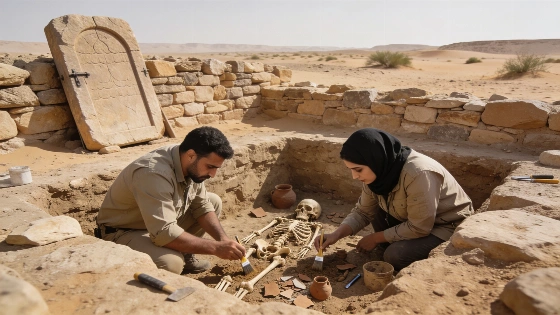
Archaeologists have identified a substantial prehistoric settlement on Hungary's Somló Hill through metalwork deposits, craft tools and ceramics dating from the Late Bronze Age into the Early Iron Age.
Somló Hill was not simply a place where Bronze Age objects were lost. Three years of investigation now point to a substantial settlement with local craft production, deliberate deposits and a history extending across nearly eight centuries.
The new research program began in 2023 under archaeologists from the Hungarian National Museum, including Tamás Péterváry, Bence Soós and János Gábor Tarbay. A National Geographic Hungary report describes the project's expanding survey record and the team's current interpretation of the site.
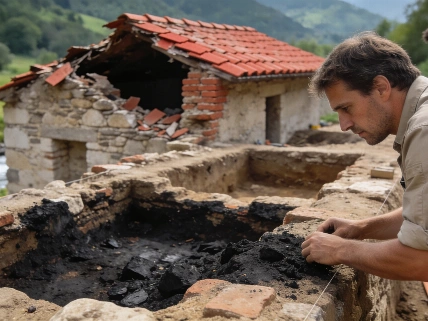
Archaeologists have recovered ceramic fragments, detached axe blades, hammers and chisels alongside equipment linked to metal casting, stoneworking and weaving. The combination matters because it moves the interpretation beyond isolated metal finds: the hill supported activities that required specialist knowledge and a settled community capable of organizing production.
The site appears to have been inhabited continuously from approximately 1200 to 450 BCE. That range spans the Late Bronze Age and Early Iron Age and does not describe one unchanged settlement. Researchers suggest that Somló may have passed through several phases of development, decline and rebuilding before its role shifted toward greater ceremonial importance.
The evidence is extensive but still preliminary. Unlike controlled laboratory studies commonly reported in Nature, archaeological interpretation depends on the spatial relationship among objects, layers and features. The project therefore requires documented context rather than statistical significance tests alone; no p-values or confidence intervals have been reported for the settlement interpretation.
Three years of fieldwork included approximately 100 metal-detector surveys and identified 12 additional deposits containing ornaments and beads made from shell, amber and glass. The scale and repetition of these discoveries strengthen the case for deliberate deposition, although they do not establish one explanation for every deposit.
In May 2026, an early major deposit was found about 30 centimeters below the surface by archaeological volunteer Gábor Révész. It contained two spears beside two large pins with heads resembling poppy seed pods. Further excavation produced bronze weapons, tools, bracelets, beads and hair ornaments dated to approximately 960-900 BCE.
Researchers then expanded the survey across Somló. The repeated grouping of bracelets, anklets, hair ornaments and necklaces with shell, amber and glass beads has led the team to favor deliberate deposition over simple concealment during conflict. The available evidence, however, does not establish whether every deposit was ritual, commemorative, political or practical.
One deposit was placed above a layer of wild boar tusks at a location overlooking Ság Mountain and the Alps. That setting has encouraged a ritual interpretation, but the physical evidence shows deposition and association rather than the beliefs or intentions of the people who placed the objects. Comparisons with earlier Hungarian finds can provide context for metalwork discoveries, but they cannot by themselves identify Somló's community.
Some finds indicate unusually fine technical work. Needles associated with clothing production add evidence for skilled manufacture, while casting debris and tool fragments suggest that metalworking and other crafts were carried out on or near the hill. Archaeologists have proposed that the settlement included an elite community with specialist craftspeople and military leaders. Traces interpreted as evidence of feasting may support a socially differentiated setting, but no individual's rank or occupation can be assigned from these objects alone.
The settlement would have depended on the surrounding landscape. Communities nearby may have cultivated millet, wheat and lentils while raising livestock to support people living on the hill. Those agricultural possibilities are part of the broader interpretation rather than direct evidence that every Somló resident followed the same subsistence strategy.
Somló's modern identity as a vineyard landscape and the presence of a medieval castle sit above a much older archaeological record. Nineteenth-century researchers had already identified important Early Iron Age burial mounds with similarities to finds from Hallstatt in Austria, yet systematic investigation of the mountain's prehistoric past then largely stopped for more than a century.
The project's analytical logic resembles other interdisciplinary work in archaeology: field mapping establishes distribution, excavation tests stratigraphic relationships, and laboratory study can characterize materials and chronology. Institutions such as the Max Planck Society and CERN demonstrate how much complex historical reconstruction can depend on coordinated instrumentation and specialist expertise, but no CERN or Max Planck analysis is reported as part of the Somló project.
Researchers still need to establish how the settlement was organized and how its inhabitants interacted with neighboring communities across the Carpathian Basin. Restoration, laboratory testing and scientific analysis are under way, with targeted excavations planned. The project also aims to clarify the population's origins and Somló's connections with other major centers, but the current material cannot by itself resolve those questions.
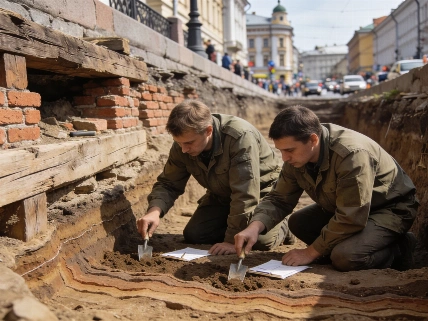
János Gábor Tarbay estimates that fully investigating the site could take as long as 20 years. That timescale is proportionate to the problem: surface deposits reveal concentrated activity, while settlement layout, production zones and changing functions require controlled excavation and documented context. Metal-detector discoveries are valuable for mapping distribution, but they cannot replace stratigraphic evidence for reconstructing sequences of occupation.
Stratigraphy is the study of how layers and deposits relate to one another through time. At Somló, an object found above wild boar tusks has a documented physical relationship to that layer, but the relationship does not automatically reveal whether the deposit was religious, political, commemorative or practical. The strength of the project lies in the convergence of deposits, tools, ceramics and craft evidence across the hill.
Somló should therefore be treated as a major prehistoric settlement under investigation rather than as a fully explained ritual center. The reported occupation from about 1200 to 450 BCE, the 12 additional deposits and the evidence for specialized production provide a strong foundation for further research, while the next two decades of contextual work will determine how much of the current interpretation survives.