A branded "官" mark and the arrangement of three waterlogged hulls offer rare material clues to official shipping near ancient Beijing, while researchers continue to refine the vessels' dates and history
A Chinese character meaning "official" was found marked on ship components, tying three ancient hulls to government-associated water transport. The vessels were recovered about seven meters below ground in Fengtai District, near the former Yongding River channel, the Lize Financial Business District and the ruins of a gate of Jinzhongdu.
The Beijing Municipal Institute of Archaeology excavated the wrecks from November to December 2025 as part of preliminary archaeological work supporting redevelopment of Wanquansi Village. The excavation was approved by China's National Cultural Heritage Administration. Researchers date the vessels to the Han and Jin dynasties, roughly 1,800 years ago. Beijing's municipal government has described them as the first physical evidence of ancient inland water transport identified in the Beijing area, a major find for the study of northern China's Han-Jin navigation.
Ships in a river bend
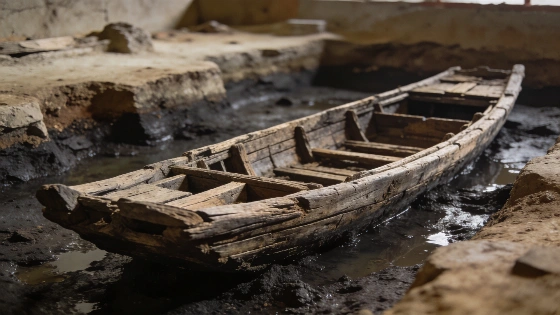
The vessels, designated Yongding River No. 1, No. 2 and No. 3, lay in an ancient river bend with all three bows pointing southwest. Geological analysis places the site in a bend or possibly a sheltered bay that may have provided a suitable location for mooring. The Beijing Municipal Government describes all three as flat-bottomed wooden boats.
Yongding River No. 2 is the best-preserved hull. It measures about 14 meters long and 2.5 meters across at its widest point, with roughly 0.9 meters of the vessel's height surviving. Ten hollow beams divide its interior into nine compartments. Reported components include bow and stern sealing boards, bottom boards, rudder boards, outer planks, deck boards, tow timber and a mast base.
Evidence on the other vessels may help explain their condition. Yongding River No. 1 was damaged, but its upper and lower sections were arranged in an orderly way and supported by upright wooden planks. Part of Yongding River No. 3's bow shows cutting that may relate to repair work. The vessels' shared southwest orientation and their position in the river bend have informed archaeologists' interpretation that they may have been gathered near a dock while awaiting repairs.
Ding Lina, a research fellow at the Beijing Municipal Institute of Archaeology, said the damaged boats may have been concentrated near a dock awaiting repair. A flood and rapid sediment burial have been proposed as part of the sequence that preserved them, but the circumstances remain an interpretation rather than a confirmed account of how the ships entered the river deposits.
Marks and material
The character "官" means "official." Several components of the best-preserved vessel carried seal-script versions of the mark. Ding said the inscriptions provide physical evidence for studying government-run grain transport and material-management systems during the Han and Jin periods. The mark points to an institutional connection, but does not identify a particular bureau, route or cargo.
The hulls also preserve evidence of construction techniques. Bottom boards were joined with mortise-and-tenon connections reinforced by wooden pegs; outer boards were interlocked with hooked joints, while iron nails strengthened outer and upper boards. The archaeological context also included a 13-centimeter wooden oar model from Yongding River No. 2. Pottery and tiles were recovered, along with animal remains from species including horses and cattle. A headless human skeleton found in Yongding River No. 3 was identified as a woman about 25 years old. Researchers consider the body's position potentially consistent with drowning, while the circumstances of her death remain uncertain.
Comparisons with other excavations can help readers distinguish mapped features from excavated evidence; a Buto excavation report, for example, describes geophysical anomalies later tested through excavation. In Beijing, the ship hulls themselves were recovered as physical structures, while their function and final moments remain open to interpretation.
Preserved beneath sediment
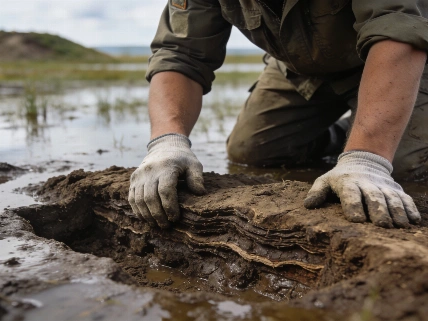
Waterlogged deposits helped protect the wooden vessels. Silt and sand sealed the hulls from much of the oxygen that would otherwise have accelerated timber decay. Archaeologists collected more than ten boxes of sediment samples from the ships and surrounding deposits for laboratory study.
Radiocarbon dating is being considered alongside stratigraphic evidence and artifact analysis to refine the chronology. Researchers are also examining pollen, phytoliths and other microscopic remains to reconstruct the river environment. These analyses may clarify the ancient landscape, while the reported dating remains under refinement.
The wrecks were found in an area associated with the ancient Yushui waterway. Their flat-bottomed, elongated hulls, shallow draught and gently rising bows appear suited to inland rivers with shallow stretches and changing water levels. The vessels have been removed and preserved as complete units.
The buried channel records a landscape very different from modern Fengtai. Beijing water-history reporting connects the find with long-term changes in the Yongding River's course; Ma Dongchun, a senior engineer at the Beijing Water Science and Technology Institute, described the boats as physical evidence that the river had shifted over time. The discovery adds rare working vessels to a regional archaeological record more often represented by tombs, settlements and other terrestrial remains.
Officials describe the three boats as among the largest and most structurally complete ancient inland vessels of their period discovered in northern China. Research on the site continues, with the vessels and associated river-channel remains providing material for studying Han-Jin navigation, government-associated transport and the history of the Yongding River.
Beijing's official account of the excavation identifies the discovery as a major archaeological breakthrough for research into ancient inland navigation. The Beijing Water Authority's report discusses the construction details and the significance of the "官" marks for studying government-linked transport.