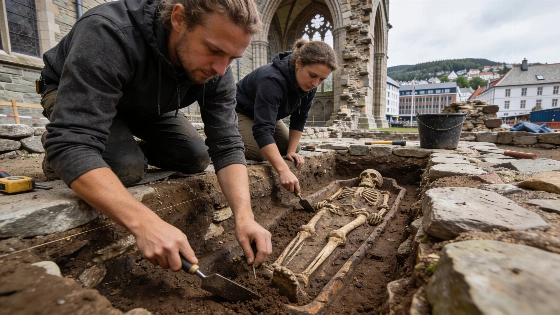
A skeleton buried with its head toward the east has provided the evidence researchers were missing at Qinngua, where a substantial stone building had long been suspected to be a church
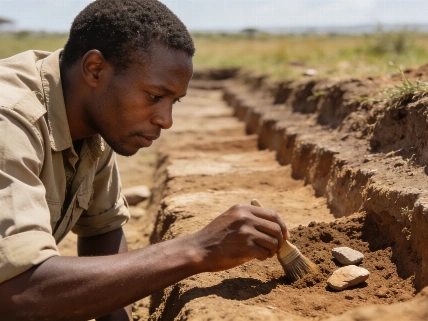
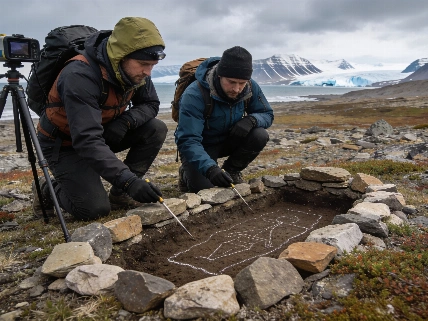
At Qinngua, near Narsarsuaq in southern Greenland, a skeleton was found inside a rectangular stone enclosure beside the remains of a substantial building. Its head was positioned toward the east, an orientation consistent with Christian burial practices.
That evidence supports the identification of the building as a Norse church. Earlier excavations had suggested a church and cemetery stood at the site, but had not uncovered graves. The burial provides the first grave evidence from the site and adds to the case for a Christian church beside the enclosure.
The site lies close to Brattahlíð, the settlement associated with Erik the Red and one of the principal Norse centers in Greenland's Eastern Settlement. The National Museum of Denmark says it is the first Norse church discovered in Greenland in more than 60 years.
Dating the Structure
Researchers found numerous hewn stones in the comparatively large building. Those features are commonly associated with construction between AD 1100 and 1300, but they do not establish a precise date for this church. The skeleton's arms lay alongside the body, a position that archaeologists say could indicate an early medieval burial.
The church's construction date and duration of use remain undetermined. Further analysis of the burial and other excavation samples is underway; the burial's eastward orientation informs the church identification but does not by itself date the building.
Two or three farm remains have also been identified nearby. Their presence raises the possibility that the church served a small cluster of Norse farms rather than standing alone.
A Wider Church Landscape
Researchers count six churches in the area around Brattahlíð and believe only three continued to function into the Middle Ages. Building a church may also have offered powerful families a way to display wealth and authority while strengthening their social position.
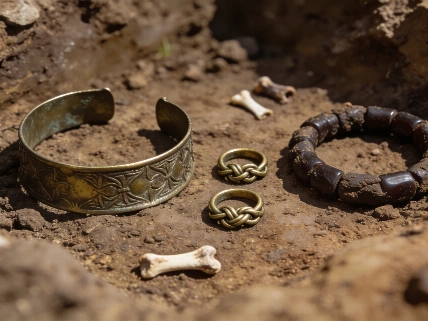
The interpretation of burial evidence depends on context. A Celtic burial in Bavaria, for example, contained ornaments and animal remains, while the deposit's meaning remains uncertain. At Qinngua, the east-facing burial supports a Christian identification, but it does not establish when the building was constructed or how long it was used.
The location also prompts a question about a church recorded in medieval writing. Researchers are examining whether the ruins could be Kirkja undir Sólarfjöllum, translated as the "Church under the Sunny Mountains". They consider the description a possible match for the landscape around Qinngua, where mountains near Greenland's ice sheet can experience frequent sunshine. The proposed identification has not been confirmed.
Erik the Red's Region
Qinngua is near Brattahlíð, in present-day Qassiarsuk, which became an important political center in the Eastern Settlement. Erik the Red, or Eiríkr rauði, is traditionally credited with establishing the first lasting European settlement in Greenland in the late 10th century.
Medieval Icelandic traditions say Erik was born in Norway and moved with his family to Iceland. After disputes and killings, he was outlawed for three years. During that exile he sailed west, explored Greenland's southwestern coast and later returned to Iceland to encourage settlement. The tradition credits him with naming the land "Greenland" to attract colonists.
Around the end of the 10th century, settlers established communities that became known as the Eastern and Western Settlements. Erik's son Leif Erikson is traditionally credited with reaching North America around AD 1000. Sagas also say Erik remained attached to Norse religion as Christianity spread, while his wife Thjodhild converted and had a church built near Brattahlíð. The accounts were written generations after the events, so they require caution as historical evidence.
The Qinngua church may be part of that wider Christian landscape, but its relationship to the better-known settlement and the neighboring farms remains to be established. Researchers are continuing analysis of the burial and other samples from the excavation.