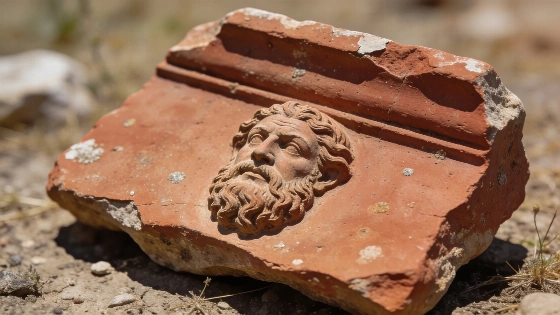
A small Silenos face survived on a Roman-period coffin broken apart by land-levelling near Attouda. Its unusual relief may have served a funerary purpose, but the disturbed context limits what researchers can establish
Land-levelling broke apart the burial before surviving fragments were discarded beside a wooded area. The pieces later recovered near Attouda preserve a rare detail: a bearded face identified as Silenos, a figure associated with Dionysos. The six surviving pieces-two from the cylindrical body and four from the lid-were later transferred to the Denizli Museum.
The image may have been intended to protect the dead, according to a study by Associate Professor Bilge Yılmaz Kolancı of Pamukkale University. That interpretation is plausible within ancient funerary practices, but the find's disturbed context prevents researchers from tying the coffin to an intact tomb or a specific burial history. No grave goods accompanied the fragments, limiting the evidence for dating and the circumstances of the burial.
A damaged context
Archaeological surveys in 2023 found fragments in an agricultural field in the Musalla locality, south of ancient Attouda in modern Denizli Province, western Türkiye. Much of the coffin is missing. The burial had been disturbed when the agricultural plot was levelled, and the fragments were discarded near a wooded area.
Weathering further affected the surviving surfaces, with lichen and mineral deposits among the signs of deterioration. The pieces therefore do not come from an undisturbed grave, and no associated grave goods survived to help establish a secure date. The coffin is provisionally dated to the first or second century CE, based on comparisons with similar material rather than a closed archaeological context.
That limitation matters when interpreting the decoration. The study appeared in volume 14 of Cedrus: The Journal of Mediterranean Civilisations Studies, on pages 309-322. Kolancı's article, "Terracotta Cylindrical Sarcophagus with a Silenos Head Relief from the Necropolis of Attouda," describes the find and its comparative dating. As with the Behbeit El-Hagar finds, uncertainty about an object's original setting constrains what can be said about its relationship to the surrounding archaeological record.
Reading the relief
The high-relief face sits at the center of a slightly convex lid. It measures 4.8 centimeters high, 4.3 centimeters wide and 2.5 centimeters deep. The surviving lid fragment measures 33 by 30.5 centimeters. The face's large circular eyes and broad, flattened nose are paired with deeply cut lips and a short beard. A Greek letter Beta, about 7 centimeters high, is incised beside the face.
Researchers compare the figure's exaggerated features and apparent age with ancient depictions of Silenos, especially masks associated with the cult of Dionysos. In Greek mythology, Silenos was a companion and tutor of Dionysos. The letter may have marked the workshop or craftsman. Neither it nor the relief appears on the other surviving lid pieces, so its purpose remains uncertain.
The relief is reported as having no known parallel among cylindrical terracotta sarcophagi from Anatolia. The cylindrical body measured approximately 55 to 60 centimeters in diameter. Its original length cannot be established; comparable coffins were generally about 1.8 to 2 meters long. The material was reddish clay containing abundant mica, with lime also present. The study interprets the Attouda example as locally made.
The placement may also be significant. Researchers suggest the decorated part of the lid could have been positioned above the deceased person's face. In that arrangement, the Silenos image might have functioned as a symbolic guardian. The coffin's missing sections and lack of a secure burial context mean that this reconstruction cannot be confirmed.
Dating and production
Typological and iconographic comparisons place the coffin provisionally in the first or second century CE, during the Roman Imperial period-roughly 1,900 years ago. This is a comparative date, not a direct measurement of the terracotta. The researchers relied on the coffin's form and imagery because the original archaeological context had been destroyed.
Cylindrical terracotta sarcophagi are known elsewhere in the region. Comparable examples have been recorded at Trapezopolis. They are also known from Laodikeia and Hierapolis. Their similarities support the possibility of a regional manufacturing tradition, while the fragility of large terracotta coffins makes nearby production a reasonable interpretation rather than a demonstrated fact about this particular workshop.
Attouda was an important settlement during the Roman Imperial period, when archaeological investigations found architecture and inscriptions alongside sculpture and terracotta objects. Surveys carried out between 2021 and 2023 have also added information about its burial traditions. Many tombs in the area have been damaged by illicit digging or other disturbances, making the surviving coffin a significant but incomplete piece of evidence for local funerary practice.
In funerary archaeology, an apotropaic image is one understood to ward off harm. Grotesque or exaggerated faces sometimes appear in ancient burial settings and have been interpreted as protective. The idea that a threatening image could deter supernatural forces offers a possible explanation for the Silenos relief, but it cannot establish what the coffin's makers or the deceased's community believed.