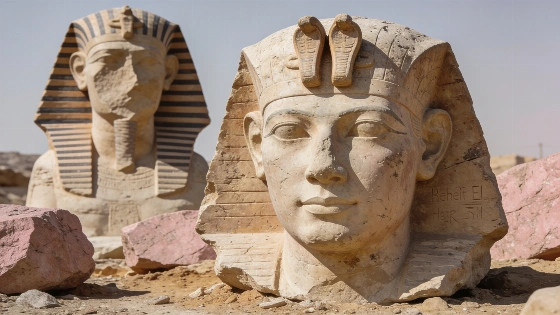
A carved head and a second monumental figure found at Behbeit El-Hagar are tentatively linked to Ramses II. Their original setting and relationship to the site's later temple remain unestablished
Rescue excavations at Behbeit El-Hagar in Egypt's Nile Delta have uncovered the remains of two colossal royal statues. The discovery was announced on 13 October 2026 by Egypt's Supreme Council of Antiquities. The first statue is identified as Ramses II through an inscription; the second is tentatively attributed to the king based on its facial features and royal headdress.
The excavation followed a local resident's discovery of an inscribed stone block while working on land in front of his home. He reported it to the Behbeit El-Hagar Antiquities Inspectorate, which completed the required procedures and organized an archaeological committee. A specialized team from the Supreme Council of Antiquities then carried out the rescue excavation. Supreme Council secretary-general Hisham el-Leithy said that work and archaeological study were continuing.
A granite head about 1.60 meters high survives with part of its back pillar, the support often carved behind Egyptian royal figures. The king wears the double crown, combining the White Crown of Upper Egypt and the Red Crown of Lower Egypt. The back pillar preserves the Horus name "Hor-ka-nakht-mery-maat," used to identify Ramses II. Based on the head's dimensions, archaeologists estimate that the complete statue, including its base, may have stood about 8.5 meters tall.
The second statue survives as a section about 2.40 meters long, without its legs or base. It wears the striped nemes headdress, and its face is described as well preserved. Archaeologists note similarities between its facial features and those of the first figure, supporting a tentative identification as Ramses II rather than a definitive one.
A pink granite block about 1.30 meters long was found roughly one meter north of the second statue. Its hieroglyphic fragments include the royal titles "Nesu-biti," meaning "King of Upper and Lower Egypt," and "Sa-Ra," meaning "Son of Ra," linking the inscription to Ramses II. The block's original position and whether it belonged to either statue remain under investigation.
Behbeit El-Hagar is associated with the ancient settlement of Behbeit and the ruins of the Iseum, a major temple dedicated to Isis. The area also contains earlier archaeological layers. The statues' installation date and their relationship to the surviving temple remain subjects of archaeological study.
The scale of the estimated statue is comparable to other monumental images of Ramses II in Egypt. At Mattaria in Cairo, archaeologists previously recovered fragments of a quartzite statue estimated to have been about eight meters tall, with removal and transport to the Egyptian Museum discussed. A restored colossus at Luxor Temple stands 11 meters from base to crown and weighs about 75 tonnes. A report by Ahram Online described the Behbeit El-Hagar discoveries and the ongoing examination of the finds.
The Supreme Council of Antiquities is continuing to search for additional fragments and to document the relationship between the two statues, the inscribed block and surrounding archaeological remains. The excavation is focused on studying and recording the finds; no final reconstruction or museum transfer has been announced.
Archaeologists distinguish between identifying a king through an inscription or royal attributes and establishing where a statue originally stood. At Behbeit El-Hagar, the inscription on the first statue provides the clearest identification, while the second figure's attribution remains tentative. The excavation's continuing work will document the objects and their archaeological setting.